Hitori Logic Puzzles Vol 1 Easy – A Smart Product for Puzzle Publishers
If you have been building a catalog of activity books for KDP or Etsy, you already know that finding quality puzzle content that actually works out of the box is harder than it looks. Many puzzle interiors on the market feel rushed, with grids that repeat patterns or lack the polish that keeps solvers engaged. Hitori Logic Puzzles Vol 1 Easy changes that. This 9x9 grid collection, engineered from a custom algorithm, gives you a clean, tested, and immediately usable product that fits right into the logic puzzle niche. Whether you are publishing in English or French under the label Jeux de Logique, this interior is a practical asset for growing your shop.
What Makes Hitori Logic Puzzles Vol 1 Easy Different
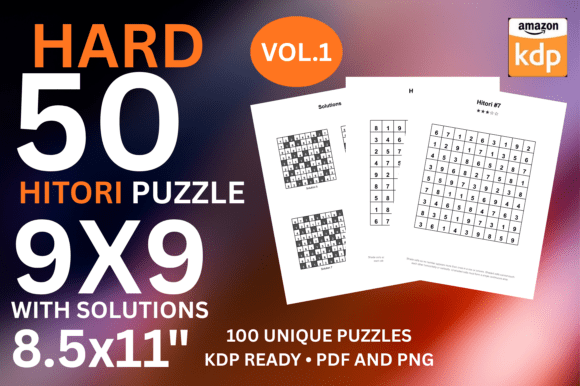
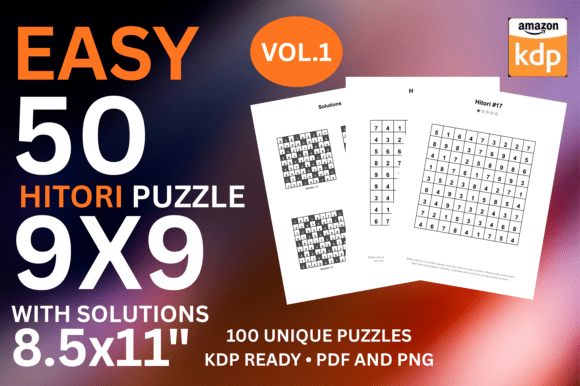
The first thing you notice with this collection is the level of precision. Each of the 50 puzzles has been generated using a high-precision algorithm, not randomly thrown together. That means you get unique grids every time, with no duplicates and no broken logic. The rules are straightforward: shade cells so that each number appears only once per row and column, no shaded cells touch each other vertically or horizontally, and all unshaded cells form a single connected path. It is a clean logic mechanic that appeals to both casual solvers and puzzle enthusiasts who appreciate structured challenges.
From a visual standpoint, the interior uses a simple, unfussy layout. The 8.5 x 11 inch pages have no bleed, which makes them easy to format for print-on-demand platforms. The grids are clearly spaced, and the solution pages at the back are equally clean. If you have ever struggled with puzzle interiors that feel cramped or misaligned, you will appreciate how this one handles spacing and readability. The personality here is one of clarity and reliability: it does not try to be flashy, and that is exactly what sells in this market.
Where This Puzzle Interior Works Best
This product is designed for print and digital use. The high-quality PDF format, along with individual PNGs of each puzzle, gives you flexibility for different sales channels. On KDP, you can drop the PDF directly into your book template and publish with minimal editing. On Etsy, the PNGs allow you to offer individual puzzle sheets or sample packs that customers can download and print at home.
Publishers targeting niche audiences will find this particularly useful. The logic puzzle community is active and growing, with dedicated buyers who seek out new content regularly. Hitori Logic Puzzles Vol 1 Easy fits well in a series of puzzle books, as a standalone title, or as part of a larger bundle that includes Sudoku, Slitherlink, or Fillomino puzzles. If you publish in multiple languages, having the rules already translated into French saves you time and reduces the risk of translation errors. The product is ready for both the English Logic Games market and the French Jeux de Logique audience.
Beyond book publishing, these puzzles work great as content for blogs, newsletters, or membership sites where subscribers receive a new puzzle each week. The PNG format makes it easy to share on social media or embed in email campaigns. If you run a puzzle subscription box, the printable format gives you a low-cost way to add value without creating new content from scratch.
How the Design Supports the Solving Experience
Readability is everything in a puzzle book. If the solver cannot quickly scan the grid and distinguish numbers, the experience falls apart. The layout here prioritizes that scanning ease. The numbers are printed at a comfortable size for 9x9 grids on a standard page, with enough padding around each cell to prevent visual clutter. The shading areas are clearly marked, and the solution grids are consistent in format so that checking answers does not become a chore.
Visual hierarchy matters in puzzle design just as it does in branding or editorial work. The clean grid structure gives the solver a clear starting point. The rules block at the top of each page is kept brief and consistent, using bold for key terms like rows and columns and including visual examples where applicable. This reduces friction for new solvers while experienced players can skip straight to the puzzle. That balance between accessibility and depth is what keeps puzzle books selling, and this interior handles it well.
Consistency across the 50 puzzles also builds trust with the buyer. When a customer purchases a book, they expect the same quality from puzzle one to puzzle fifty. Because the algorithm generates each grid independently with no pattern repetition, you avoid the common complaint of puzzle books feeling like the same puzzle rearranged. The solutions are fully verified, so you also eliminate errors that frustrate solvers and lead to negative reviews.
Practical Guidance for Using This Product
If you are considering adding this interior to your catalog, start by thinking about your audience and your format. For KDP, the no-bleed PDF allows you to upload directly into Kindle Create or similar tools with no need for trimming or margin adjustments. Test a sample print before publishing to confirm that the numbers appear crisp and the grid lines are sharp. Most print-on-demand services handle this size well, but checking your own proof is always worth the time.
For Etsy sellers, the individual PNGs open up several options. You can create a listing for the full set of 50 puzzles as a digital download, or break them into smaller packs of 5 or 10 puzzles for a lower price point. Consider offering a free sample with one puzzle and the rules sheet to give buyers a feel for the quality. That small step often increases conversion rates for puzzle products.
If you are targeting the French market, make sure your product description and keywords reflect that. Use terms like jeux de logique, grilles 9x9, and casse-têtes on your listing pages. The interior already includes the rules in French, which is a significant advantage because many puzzle interiors require you to create your own translation or omit it entirely. That alone can make your listing stand out to French-speaking buyers.
When evaluating this interior for your brand, consider how it fits with your existing offerings. If you already sell Sudoku or Kakuro books, adding Hitori gives your customers another logic option without straying too far from the genre. If you are new to puzzle publishing, this is a solid starting point because Hitori is less saturated than Sudoku but has a dedicated following. The 9x9 grid size is approachable for beginners while offering enough depth for regular solvers, making it a versatile pick for building an audience.
Why This Product Works for Publishers and Creators
Time is the most valuable resource for a small publisher. Creating 50 unique puzzles with verified solutions from scratch would take hours, if not days, of manual work. With a ready-to-use interior, you skip that production phase entirely and go straight to formatting and listing. The algorithm behind this collection ensures that every puzzle is logically sound, which means you are not spending time testing or fixing errors. That efficiency is what makes this product a practical tool for scaling your puzzle catalog.
From a branding perspective, a consistent and professional puzzle book builds recognition over time. Customers who enjoy one of your books are far more likely to buy another if the quality and format feel familiar. Using Hitori Logic Puzzles Vol 1 Easy as part of a series lets you create that repetition without reinventing the design each time. You can pair it with other interiors from the same producer to build a cohesive library of puzzle content.
There is also the question of commercial licensing. This interior is designed for commercial use, which means you can include it in products you sell without worrying about rights issues. Always confirm the specific license terms for your use case, but the product is marketed specifically for KDP and Etsy sellers, which indicates that commercial publishing is the intended purpose. This removes a common barrier that creators face when sourcing content.
Thoughts on the Logic Puzzle Market
The demand for logic puzzles has stayed steady over the last decade, with notable growth in digital and print-on-demand channels. Hitori, also known as Alone in Japanese, has carved out a loyal niche among solvers who enjoy the spatial reasoning aspect of shading and connectivity rules. It is less widely known than Sudoku, which works in your favor as a publisher: you face less competition while still targeting an audience that actively seeks new puzzles. The cross-language appeal of this product, with rules in both English and French, also opens up larger market potential without requiring additional localization work.
Buyers of puzzle books tend to value quantity and quality equally. Fifty puzzles is a solid count for a single volume, and the 9x9 grid size strikes a comfortable balance between solving time and page count. If you are planning a series, you can label this book as Volume 1 and use the same format for subsequent volumes, adjusting difficulty levels as you go. That builds customer loyalty and gives you a repeatable product structure.
The clean, no-bleed design also means you can repurpose these puzzles for other formats, such as large print editions or spiral-bound versions, without needing to rework the layout. That flexibility is something to keep in mind as your product line grows. A single interior can serve multiple formats, saving you production costs in the long run.
Making the Most of Your Investment
Once you have the interior ready, think about how you present it to buyers. The product itself is strong, but the listing page matters just as much. Use clear mockups that show the grid layout and the solution page. Highlight the number of puzzles, the verified solutions, and the dual-language rules. If you can include a screenshot of a solved puzzle, that helps buyers understand the mechanic at a glance.
Keywords are important, but keep them natural. Terms like logic puzzle book, Hitori puzzle collection, 9x9 grid puzzles, brain teaser for adults, and printable puzzle PDF all describe the product without feeling forced. For the French market, use casse-tête logique, grilles 9x9, and jeu de déduction. Test a few combinations and see what drives traffic to your listings.
Finally, consider collecting feedback from early buyers. If they mention that the puzzles are well-leveled or that the layout makes solving easy, incorporate those phrases into your product descriptions. Real customer language often performs better than marketing copy because it feels authentic. This interior gives you a strong foundation, and listening to your audience will help you refine how you present it.
Hitori Logic Puzzles Vol 1 Easy is a practical, ready-to-use product for anyone building a puzzle catalog. The algorithm-driven grids, clean formatting, and bilingual rules remove the biggest headaches of puzzle publishing while giving you a product that buyers actually enjoy. Whether you are launching your first title or expanding an existing line, this interior delivers consistent value without the usual production overhead. If you have been looking for a logic puzzle product that works from day one, this one is worth your time.