The March Wind and the Little Kite – A Spring Tale of Adventure and Heart
There is something deeply evocative about a kite climbing into a bright March sky. The tug of the string, the rush of the wind, the way a small shape becomes a distant speck of color against the clouds—it is a scene that speaks to children and adults alike. The March Wind and the Little Kite captures this moment with warmth and authenticity, following little Leo as he ventures outside on a breezy morning with his brand-new red kite. What begins as a simple outing quickly becomes something more: a dance between a boy, the wind, and a kite that seems almost alive. When the wind strengthens and the string snaps, Leo is launched into an unexpected journey—one that tests his courage, deepens his friendships, and reveals the quiet magic of spring. This is not merely a story about losing a kite. It is a story about trust, resilience, and the bonds that form when we least expect them.
The Emotional Core: Why Leo’s Story Resonates
At the heart of The March Wind and the Little Kite is a universal childhood experience: the mix of excitement and vulnerability that comes with chasing something precious. Leo is not a superhero or a fantastical creature. He is a curious child who feels the same flutter of hope and pang of loss that any young reader can recognize. When the kite flies away after that sharp SNAP, the moment lands with genuine emotional weight. Yet the story never lingers in sadness. Instead, it shifts toward problem-solving and connection. Leo’s search for his kite introduces him to a girl friend who helps him look, and together they navigate fields, trees, and open skies. The narrative gently teaches that asking for help is not a weakness—it is a form of strength. The kite becomes a symbol not just of play, but of the friendships that lift us when we feel untethered.
For parents and educators, this emotional arc offers a natural entry point for discussions about perseverance, empathy, and the importance of community. The story does not preach. It simply shows a child feeling disappointed, then choosing to act, then discovering that he is not alone. That sequence is far more powerful than any moral stated outright. The March wind, with its playful yet unpredictable personality, serves as both a challenge and a collaborator—a force that tests Leo but also carries his kite to new places, ultimately leading him to new connections. Children who read this story internalize the idea that setbacks can open doors, and that spring—with its winds and blossoms—is a season of renewal in every sense.
The Characters and Their Symbolic Weight
Every character in The March Wind and the Little Kite carries layered meaning. Leo represents the eager spirit of childhood—bold, hopeful, and still learning the boundaries of his own capabilities. His red kite is more than a toy; it is an extension of his imagination, a piece of himself that he sends into the sky. When the kite breaks free, it mirrors the way children begin to test independence, sometimes pulling away faster than expected. The wind itself is almost a character: sometimes a gentle playmate, sometimes a wild force, always present. The girl friend who appears during the search is not a sidekick but an equal partner, embodying the collaborative problem-solving that defines healthy relationships. Together, they model what it means to share a goal, to communicate, and to celebrate when the kite is finally found—likely tangled in a tree or resting in a field of spring flowers.
The natural world in the story is alive with detail. Bright ☀️ sunny skies, drifting ☁️ clouds, rustling 🌳 trees, and clusters of 🌸 spring flowers create a vivid backdrop that feels both real and idyllic. Birds (🐦) cross the sky as silent witnesses, and the overall palette of the narrative leans toward the fresh greens, soft blues, and vibrant reds of early spring. These visual cues are not decorative; they reinforce the emotional tone of each scene. When Leo feels hope, the sky is wide and clear. When he feels uncertainty, clouds drift in. The illustrations—or the mental images the text conjures—work in concert with the story’s beats, making The March Wind and the Little Kite a richly sensory experience for young readers.
Practical Applications for Creators, Educators, and Parents
Beyond its narrative charm, this story has real-world utility for a variety of audiences. For educators, the book serves as an excellent springboard for lessons on seasons, weather, and emotional literacy. The March wind can spark discussions about air movement and how kites fly, blending literature with basic science. The theme of friendship supports social-emotional learning objectives, and the simple plot structure makes it easy for early readers to retell in their own words. Teachers can pair the story with a kite-building or kite-flying activity, turning a reading session into a hands-on exploration of physics and art.
For parents, the story offers a screen-free way to talk about feelings and resilience. Reading The March Wind and the Little Kite together creates space for children to share their own experiences of losing something important—whether a toy, a pet, or a friend who moved away. The story’s gentle resolution models that loss is not final and that help is always nearby. It also celebrates outdoor play in an age when children often spend more time indoors. After reading, a trip to a park or an open field with a simple kite can turn the story into a lived memory.
For creators, authors, and self-publishers, the elements embedded in this story—and its accompanying marketing assets—are a goldmine. The notable icons listed with the book (🪁 Kite, 🌬️ Wind, 🌤️ Sunny sky, ☁️ Clouds, 🌳 Trees, 🌸 Spring flowers, 🐦 Birds, 👦 Boy Leo, 👧 Girl friend, 💛 Friendship, 🌈 Joy happiness, ✨ Adventure) are designed for immediate use in KDP listings, A+ content, and cover marketing. These symbols are not afterthoughts—they are carefully chosen to communicate the story’s themes at a glance. A thumbnail showing a red kite against a blue sky with blooming flowers instantly signals a heartwarming spring tale. For anyone marketing a children’s book, this kind of visual shorthand is invaluable. The icons can be placed on covers, used in social media graphics, or embedded in product description bullets to increase click-through rates and convey emotional tone without a single word.
Product Specifications and What They Mean for You
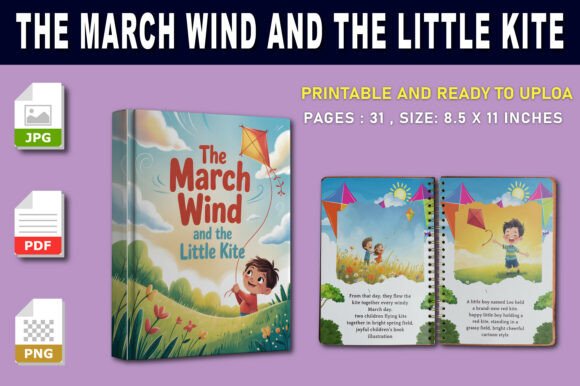
The practical details of The March Wind and the Little Kite reflect a professional approach to publishing. The book comes with ✏️ Editable Canva AI Files, meaning that anyone—from a seasoned designer to a first-time author—can tweak or scale the designs without starting from scratch. This is especially useful for creating multiple formats: hardcover, paperback, or digital versions with different aspect ratios. The 300 DPI resolution ensures that printed images remain crisp, whether on a glossy cover or an interior page. Clean white backgrounds in the 🖍️ JPG, PNG, and PDF versions make it easy to drop illustrations into any layout, and the 📄 Ready-to-Use PDF Interior is sized perfectly for instant upload to platforms like Amazon KDP. With 📚 31 Pages in Total, the book has a substantial feel without overwhelming young readers—a length that works well for bedtime reading, classroom story time, or early independent reading. The 📏 Standard Page Size 8.5" x 8.5" is a square format that suits illustrated children’s books beautifully, offering a balanced canvas for both text and art.
For indie authors and small publishers, these specifications remove many of the technical barriers to producing a high-quality book. The inclusion of Canva AI files means that even those without advanced design skills can customize elements—adding a child’s name, changing a background color, or resizing for different platforms. This democratization of book creation aligns perfectly with the story’s own themes of empowerment and collaboration. Just as Leo learns that he can face the unexpected with help, a creator learns that they can produce a professional-grade book with the right tools and assets.
The Spring Setting and Its Universal Appeal
Spring is a season of transition, and The March Wind and the Little Kite uses that setting to its fullest. March winds are famously capricious—they gust and calm without warning, much like the emotions of a young child. The story channels this energy into a plot that feels organic rather than forced. The kite’s flight and subsequent escape are not random; they are the natural result of a windy March morning. Leo’s journey to recover his kite takes him through landscapes that are waking from winter: bare trees beginning to bud, patches of crocuses and daffodils pushing through the soil, the air carrying a hint of warmth. These details root the story in a specific time and place, making it an excellent seasonal read. For families in climates where March is still cold, the story offers a promise of warmer days. For those already enjoying spring, it validates the joy of being outside.
The spring setting also reinforces the story’s themes of renewal and hope. A lost kite is found. A solo adventure becomes a shared one. A windy day that could feel frightening becomes exhilarating. Every element points toward the idea that change—even when it feels disruptive—can lead to beautiful outcomes. This is a message that resonates across ages, which is why a children’s book about a kite can be equally meaningful to an adult reading it aloud. The simplicity of the plot allows the deeper currents to flow without being heavy-handed.
Observations on Storytelling and Visual Design
One of the most striking aspects of The March Wind and the Little Kite is how seamlessly the visual and verbal elements work together. The icons provided for marketing are not generic clip art; they are direct extensions of the story’s world. The kite, the wind lines, the flowers, the birds—each icon tells a micro-story. When a potential buyer sees a 💛 heart icon next to the friendship theme, or a 🌈 rainbow next to joy and happiness, they immediately understand the emotional register of the book. This is smart marketing, but it is also honest marketing. The icons do not promise anything the story does not deliver. For creators looking to replicate this approach, the lesson is clear: every visual element should tie back to the core narrative. Consistency between cover, interior, and promotional graphics builds trust and helps a book stand out in a crowded marketplace.
The 31-page count is also worth noting. In children’s publishing, page length affects everything from printing cost to binding options to reader engagement. A book that is too short may feel insubstantial; one that is too long may lose a young child’s attention. Thirty-one pages, especially in a square 8.5" x 8.5" format, provides enough space for a complete story arc with several spreads of full illustration, while still being manageable for small hands and short attention spans. The ready-to-use PDF interior simplifies the upload process for self-publishers, reducing the risk of formatting errors that can derail a KDP submission. For anyone who has struggled with interior formatting—especially with illustrations that need to align correctly across spreads—this kind of ready-made asset is a significant time saver.
Why This Story Matters in a Broader Context
In an era of digital saturation, stories that celebrate outdoor play, friendship, and emotional resilience are more important than ever. The March Wind and the Little Kite offers children a chance to see themselves in Leo—a child who experiences a setback and finds a way forward. It models that asking for help is natural, that friendships can form in unexpected moments, and that the natural world is full of wonders worth exploring. For parents, the book provides a gentle tool for teaching these values without lectures. For educators, it integrates easily into units on weather, seasons, or social-emotional learning. For creators and publishers, the accompanying assets and specifications remove technical friction, allowing more time to focus on storytelling and connection.
The wind that blows through these pages is not just a meteorological detail. It is a metaphor for the forces that push us, challenge us, and ultimately carry us to new places. Leo’s red kite, dancing against a bright March sky, is a reminder that even when we lose our grip, the world has a way of bringing us back together. Whether you are a child reading this story for the first time, a parent sharing it at bedtime, or a creator using its assets to build your own publishing project, The March Wind and the Little Kite offers both a heartwarming tale and a practical toolkit. It is a story that lifts the spirit—much like a kite lifted by the wind.