Burnout Recovery Mental Wellness Plan
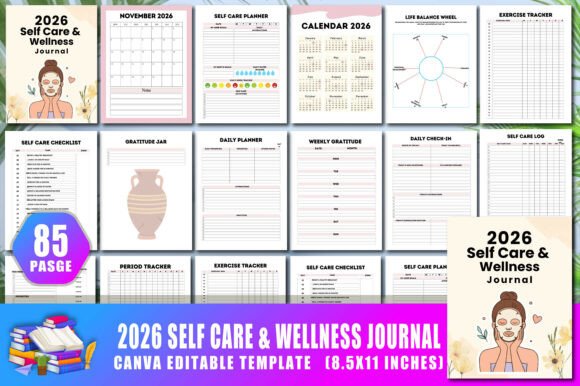
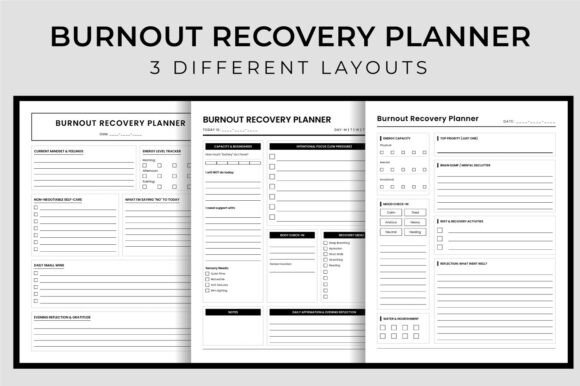
When your energy is depleted, your focus fractured, and your motivation flatlines, a generic to-do list won’t help. What you need is a structured yet flexible system that treats recovery as a process, not a quick fix. The Burnout Recovery Mental Wellness Plan, delivered across three distinct layouts in high-resolution PDF and JPG formats, offers exactly that. It combines a Burnout Recovery Planner, a Stress Relief Journal, a Self Care Daily Tracker, a Mental Health Wellness log, and an Energy Capacity Logbook into one cohesive printable set. Whether you are a freelancer juggling multiple clients, a small business owner running on caffeine, a designer staring at a blank screen, or an educator giving everything to your students, this system gives you a tangible framework to rebuild your reserves.
What makes this approach interesting is its refusal to treat burnout as something you just “sleep off.” Instead, it breaks recovery into actionable layers: planning your week around your actual energy capacity, tracking daily self-care with a concrete checklist, journaling through the stress that accumulates, and logging how your mental wellness shifts over time. The three different layouts mean you are not locked into one method. One layout might emphasize daily check-ins and habit streaks, another might focus on weekly energy mapping and reflection prompts, while a third offers a minimalist structure for those who prefer more open-ended space. Together, they form a complete toolkit that can adapt as your needs change.
Three Layouts, One Recovery System
A single planner format rarely suits everyone. Some people need guided prompts to get started. Others feel constrained by too many boxes and prefer a fluid, open layout. The Burnout Recovery Mental Wellness Plan solves this by offering three distinct variations, each 120 pages long, available as both PDF and JPG at 300 dpi. The files are sized at 8.5″ x 11″ with no bleed, ready to upload to Amazon KDP or print at home.
Layout one could be your go-to for structure. It features dedicated sections for the Burnout Recovery Planner with time-blocked scheduling aligned to energy levels, plus a Self Care Daily Tracker with checkboxes for hydration, movement, sleep, and boundaries. This layout suits marketers, bloggers, and entrepreneurs who thrive on routines and measurable progress. Layout two shifts toward reflection. It prioritizes the Stress Relief Journal and Mental Health Wellness pages, offering longer writing prompts, mood mapping, and gratitude exercises. Creators, educators, and hobbyists who process their emotions through writing will find this version more natural. Layout three takes a hybrid approach. It balances the Energy Capacity Logbook with quick journaling slots and a simplified daily tracker. This is ideal for publishers and small business owners who need practical energy management without the extra steps.
Adapting the Planner for Different Goals
The real power of this system lies in how you customize it for your specific context. If you are a freelance designer, your energy peaks might be in the late morning. Use the Energy Capacity Logbook to track when your creative flow is strongest, then block those hours for client work. Use the Self Care Daily Tracker to remind yourself to step away from the screen every ninety minutes. The Stress Relief Journal becomes a place to note recurring frustration points, like scope creep or unclear briefs, so you can address them before they drain you.
For a busy parent running a side business, the layouts can be adapted to shorter time blocks and lower energy expectations. A ten-minute journal entry in the Mental Health Wellness section, a quick check-in on the Self Care Daily Tracker, and a weekly review using the Burnout Recovery Planner can keep you aligned without adding another burden. The three PDF files allow you to mix and match pages from different layouts if you prefer, despite each being designed as a standalone book. Because they come as high-resolution JPGs as well, you can rearrange individual pages, insert them into a binder, or upload them to a tablet for digital planning.
How to Keep Your Recovery Clear and Effective
A planner only works if you use it consistently, and consistency comes from keeping the process simple. With three layouts, the risk is trying to use all of them at once and feeling overwhelmed. The smarter approach is to start with one layout that matches your current state. If you are in the thick of burnout, the layout with more guided prompts and a simpler tracker will feel less demanding. As your energy returns, you can switch to a layout that demands more intentional planning.
Keep your entries short and honest. The Self Care Daily Tracker is not a competition. Marking “I rested for ten minutes” or “I said no to one extra task” is a win. In the Energy Capacity Logbook, rate your energy on a scale from one to five at three points during the day. Over a week, you will see patterns. Maybe your energy crashes after back-to-back meetings, or your creativity is strongest when you start the day with a walk. That insight is gold. The Stress Relief Journal is most effective when you treat it as a pressure valve. Write down what is bothering you without editing. The goal is release, not literary quality.
When preparing these files for Amazon KDP, the no-bleed format and 8.5″ x 11″ size make upload straightforward. Each PDF is exactly 120 pages, though you can adjust the page count if you want to create a slimmer or more comprehensive version. The 300 dpi resolution ensures sharp text and clean graphics when printed. Because the files come as both PDF and JPG, you have full flexibility to customize covers, adjust layouts, or combine pages into a new format before publishing.
Creative Variations and Interpretations
Once you are familiar with the core system, you can adapt it far beyond the original layouts. A coach or therapist might use the Mental Health Wellness pages as a client resource, printing specific prompts for sessions. A blogger could turn the Self Care Daily Tracker into a printable bonus for their audience, offered as a lead magnet. A small business team could adopt the Energy Capacity Logbook for weekly check-ins, helping staff communicate their workload without oversharing.
You can also reinterpret the layouts for different platforms. The high-resolution JPGs work perfectly on tablets for digital planning with apps like GoodNotes or Notability. The PDFs can be uploaded to low-content book publishers on Amazon KDP directly, or you can rebrand them with your own cover and sell them as part of a larger wellness bundle. The three layouts give you a library of options rather than a single rigid product.
If you are a publisher looking to expand your KDP catalog, consider releasing each layout separately as individual journals and then bundling them together as a complete collection. The fact that each file is 120 pages and sized perfectly for KDP without bleed means you save time on formatting. You can focus your energy on cover design, description copy, and keywords. The Burnout Recovery Mental Wellness Plan itself becomes a keyword-rich category that addresses a growing need among adults navigating professional and creative burnout.
Practical Recommendations for Long-Term Use
To get the most out of this system, integrate it into your existing routine rather than treating it as a separate task. Keep your chosen layout open next to your work station. Fill in the Energy Capacity Logbook during a morning coffee or at the start of your work session. The Self Care Daily Tracker can live on your desk as a visual reminder, taking seconds to tick off. The Stress Relief Journal works best when you set a timer for five minutes at the end of the day. Overthinking defeats the purpose.
Rotate between layouts if you feel stuck. Some weeks call for the structure of the Burnout Recovery Planner. Other weeks demand the reflective space of the journal-heavy version. Listen to what your current mental state needs. The three PDFs give you that flexibility without starting over. Print fresh copies as needed, or keep digital backups so you can access them from any device.
The 300 dpi resolution means that even if you print at home or at a local shop, the text stays crisp and the lines remain clean. For KDP authors, the no-bleed specification eliminates a common formatting headache. You can upload these files with confidence that they will pass Amazon’s interior review. And because the content is evergreen, focused on foundational wellness practices rather than trends, it will remain relevant for years.
The Burnout Recovery Mental Wellness Plan is not just a set of pages. It is a permission slip to prioritize your recovery without guilt, a toolkit that respects your individuality, and a practical way to track progress when everything feels foggy. Whether you use it personally or adapt it for your audience, the three layouts offer a depth of utility that a single planner cannot match. Start where you are, use what you need, and let the system evolve with you.