2026-2027 Addiction Recovery Planner: Your Guide to Healing and Growth
Recovery is rarely a straight line. It’s full of small victories, hard days, moments of clarity, and stretches where motivation feels thin. Having a structured tool to anchor your progress can make all the difference. The 2026-2027 Addiction Recovery Planner is designed for exactly that purpose—it’s a practical, thoughtful companion for anyone committed to understanding their patterns, managing triggers, and building sustainable change.
Whether you’re navigating your own recovery, supporting a client, or creating resources for others, this planner bridges the gap between intention and daily action. Let’s explore what makes it stand out, how it works in real life, and why it might be the missing piece in your wellness toolkit.
What Makes This Planner Different?
Many planners track time. This one tracks transformation. Instead of just calendar pages, the 2026-2027 Addiction Recovery Planner weaves together practical scheduling with deep self-reflection tools. It’s built for the messy, non-linear reality of recovery—where some weeks feel steady and others require extra support.
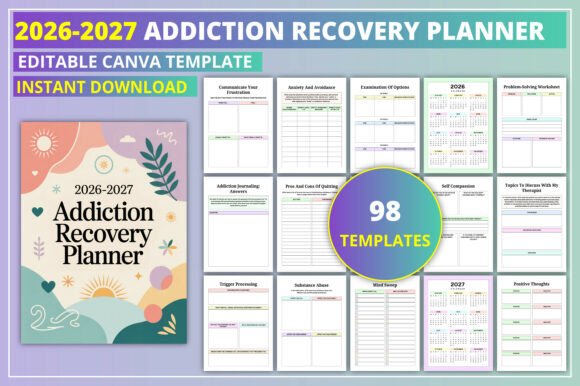
Key sections include a trigger worksheet and processing guide, stress worksheets, substance use tracking, and a dedicated space for therapy topics. There’s also a thought pattern exploration tool, weekly goal setting for substance use, and a manifestation page that keeps hope front and center. The combination of monthly calendars (January 2026 through December 2027) with daily and weekly planning pages means you can zoom in or out depending on where you are in your journey.
The planner comes as a high-quality, print-ready PDF and an editable Canva template. That dual format gives you real flexibility—you can print it for hands-on journaling or customize the digital version to fit your exact needs before printing. For therapists, coaches, and product sellers, it’s also an ideal KDP interior that requires minimal setup.
Real-World Applications Across Contexts
Addiction recovery isn’t one-size-fits-all, and this planner respects that. Here are several ways different people can use it effectively.
For Individuals in Active Recovery
If you’re personally working through addiction, the daily structure helps you stay grounded. The trigger processing pages are especially valuable—they walk you through identifying what sparks cravings, how you typically respond, and what alternative actions might work better. Over weeks and months, that pattern recognition becomes second nature. The apology letter page might seem small, but it offers a safe space to process relationships affected by substance use. You can write, delete, rewrite—whatever feels right. The weekly review ensures you celebrate wins and adjust strategies without judgment.
For Therapists and Counselors
Clinicians often struggle to find resources that clients actually use between sessions. The 2026-2027 Addiction Recovery Planner solves that problem by offering structured prompts that mirror therapeutic frameworks. The “Topics To Discuss With My Therapist” page helps clients arrive prepared, making each session more productive. You can assign specific worksheets as homework—the stress worksheet, thought pattern reflection, or pros and cons of quitting—and review them together. It turns vague “how was your week” conversations into focused, actionable discussions. Plus, the editable Canva link lets you customize sections if you want to add specific exercises or remove pages that don’t align with your approach.
For Coaches and Recovery Program Leaders
Group facilitators can use this planner as a consistent resource for participants. The support list and symptom tracker pages work well in group settings where members share strategies and check in on accountability. The communication frustration worksheet is particularly helpful for role-play exercises in group therapy—it gives people a low-stakes format to practice expressing difficult emotions. Since the planner covers two years, it also works for longer programs that emphasize sustained change over quick fixes.
For Digital Product Creators and KDP Sellers
If you sell on Amazon KDP or Etsy, the 2026-2027 Addiction Recovery Planner is a ready-to-upload interior that saves hours of formatting. The print-ready files are optimized for standard trim sizes, so you don’t need to fiddle with margins or bleed. You can publish it as-is or add your branding—cover design, logo, introductory pages—and have a professional product live quickly. The editable Canva link also means you can create variations: a minimalist version, a colorful edition, or a workbook-style layout with extra journaling space. Entrepreneurs who serve the mental health niche will find this a timely resource as more people seek structured support tools in 2026 and 2027.
Practical Benefits You’ll Notice Right Away
Usefulness matters more than bells and whistles. Here’s what stands out after working with this planner.
- Efficiency: The layout is clean and uncluttered. You won’t spend time figuring out where to write—everything has a place. Daily, weekly, and monthly views connect logically, so you can track progress across timeframes without flipping endlessly.
- Self-awareness boost: The thought discovery and pattern reflection pages are designed for honest self-assessment. They don’t assume you have all the answers. Instead, they ask questions that lead you toward your own insights. Over time, this builds internal motivation that lasts longer than external rewards.
- Communication aid: The apology page, frustration communication worksheet, and support list give you language for conversations that are often difficult to start. For many people in recovery, repairing relationships is one of the hardest parts. Having a private space to draft thoughts before speaking can reduce anxiety and improve outcomes.
- Visual progress tracking: The trigger tracker and symptom tracker turn abstract feelings into visible data. When you see a downward trend in avoidance behaviors or a pattern in substance use triggers, you gain clarity on what works. That visual feedback reinforces positive changes without needing praise from others.
- Customizability: Because it’s editable in Canva, you can change fonts, colors, and layout elements. Some users prefer a calm, muted palette for reflection pages and a bolder look for goal-setting sections. Others simplify it to black and white for easier printing. The control is yours.
How to Get the Most Out of It
Starting a new planner can feel like pressure—another system to learn, another commitment. But this one is built to reduce friction, not add it. Here are a few practical tips based on my own experience and feedback from early users.
Start small. Don’t try to fill every page on day one. Use the daily planner for a week. Add the trigger worksheet when you notice a pattern. Bring in the therapy discussion page before your next session. Let the planner grow with your practice rather than demanding perfection upfront.
Combine digital and print. If you use Canva, keep a digital copy on your phone or tablet for quick entries during the day—trigger notes, stress levels, or a thought you want to explore. Then transfer or print the physical pages for deeper journaling in the evening. This hybrid approach works well for people with busy schedules.
Review weekly without skipping. The weekly review is arguably the most powerful page. It asks you to reflect on what worked, what didn’t, and what you’ll adjust. Even a five-minute review can shift your perspective from “I failed” to “I learned something useful.” That mindset shift is critical for long-term recovery.
Use it with a support system. While it’s a personal tool, sharing certain pages with a therapist, sponsor, or trusted friend can deepen accountability. The support list page is designed for this—it reminds you that recovery doesn’t happen in isolation. Let the planner facilitate those connections, not replace them.
Who Should Consider This Planner
The 2026-2027 Addiction Recovery Planner is broad enough for many situations but targeted enough to feel relevant. It’s especially useful if you:
- Are in early recovery and need daily structure to prevent relapse
- Have been in recovery for a while and want to deepen self-awareness
- Work as a therapist, counselor, or coach and need a consistent resource for clients
- Sell digital products and want a high-quality, ready-to-use KDP interior
- Prefer worksheets that go beyond simple scheduling into genuine behavioral change
- Value customization and want a planner you can adapt to your personal style
If any of those sound familiar, this is worth trying. The two-year span also means you’re not buying a new system every twelve months—you can settle into the process and build momentum across a longer horizon.
Final Thoughts on Making Recovery Sustainable
Tools don’t heal us—we heal ourselves with the right support. The 2026-2027 Addiction Recovery Planner is a support tool that respects how complex and personal recovery truly is. It doesn’t promise quick fixes or overnight transformation. Instead, it offers a sturdy framework for noticing patterns, processing emotions, setting realistic goals, and celebrating progress—however small.
Whether you use it privately, in a therapeutic setting, or as part of a product catalog, the value lies in its consistent use. Pages get filled, insights emerge, and slowly, the path forward becomes clearer. That’s what makes it more than a planner. It’s a practice. And for anyone serious about healing, that practice is everything.