Kids Matching Activity Book: A Practical Tool for Early Cognitive Development
Early childhood learning materials vary widely in quality, and identifying resources that genuinely support skill development without overwhelming young learners can be a challenge. The Kids Matching Activity Book positions itself as a focused workbook designed to strengthen observation, logic, and memory through matching exercises. For educators, parents, and caregivers looking for structured yet engaging activities, this book offers a practical option worth examining closely.
Core Purpose and Target Audience
This activity book is built around a straightforward premise: help children aged three to six develop foundational cognitive skills through matching tasks. The exercises require children to pair items based on visual similarity, conceptual relationships, or logical connections. This type of activity directly supports pattern recognition, attention to detail, and early problem-solving abilities.
The book is most useful for adults who need reliable, ready-to-use material for home learning, preschool classrooms, or supplemental practice. Homeschooling parents, early childhood educators, and childcare providers will find it fits naturally into daily routines. The content does not require specialized training to implement, which makes it accessible for anyone working with young children.
Content Structure and Page Design
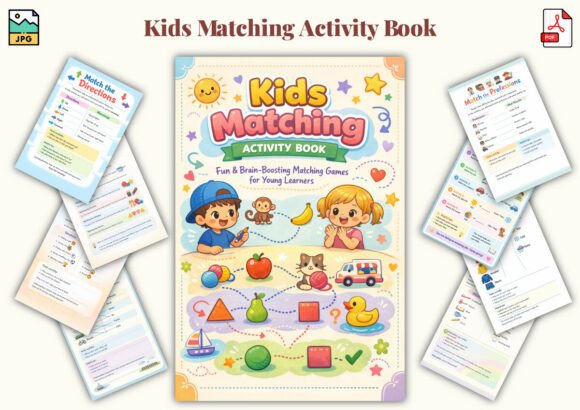
The book contains 31 unique activity pages, each presenting a different matching challenge. The variety across pages ensures children encounter multiple types of connections: matching identical objects, pairing shapes, linking words to pictures, and identifying relationships between concepts. This range prevents monotony and encourages flexible thinking.
Each page follows a clean, child-friendly layout with minimal background distraction. The design choice to keep backgrounds simple is deliberate. Young children focus better when visual noise is reduced, and the straightforward presentation helps them concentrate on the task rather than decorative elements. The 6 × 9 inch page size is manageable for small hands and fits well on standard desks or tables.
The balance between content density and white space is well considered. Pages feel full enough to offer meaningful activity but not crowded to the point of confusion. This is an important detail for children who may feel anxious about busy worksheets.
Skill Development and Learning Outcomes
Matching activities are not merely busywork. They engage several cognitive processes simultaneously. When a child examines two rows of items and determines which belong together, they practice observation, comparison, and decision-making. Over multiple pages, these small mental actions reinforce neural pathways associated with attention and logical reasoning.
The specific skills this book targets include:
- Visual discrimination – noticing subtle differences and similarities between objects or symbols
- Categorization – grouping items based on shared attributes such as color, shape, or function
- Working memory – holding information in mind while searching for a match
- Vocabulary building – connecting written or spoken words to corresponding images
- Fine motor preparation – drawing lines or pointing accurately between items
These are not abstract claims. Each skill has direct application in early literacy, numeracy, and school readiness. A child who can reliably match shapes is better prepared to recognize letters. A child who connects words to images has a stronger foundation for reading comprehension.
Real-World Usability and Practical Value
In practical use, the book performs well for short, focused sessions. A typical page takes between five and fifteen minutes depending on the child's age and familiarity with the format. This makes it easy to incorporate into morning routines, transition times, or as a calm-down activity after more energetic play.
One strength is the absence of complicated instructions. Most pages are intuitive enough that a child can understand what to do after a brief explanation. This reduces the adult's preparation time and allows for more independent work as the child gains confidence.
However, some pages may feel repetitive to children who advance quickly. The book is best used as one resource among several rather than the sole activity workbook in a child's rotation. For adults working with groups, the single-use nature of printed activity pages means multiple copies are needed, which is a consideration for classroom budgeting.
Design Quality and Presentation
The visual style is playful without being overly childish. Illustrations are clear and recognizable, which matters when a child needs to distinguish between similar items. The cute theme adds warmth but does not interfere with the learning objective.
The print quality on standard paper is adequate for pencil, crayon, or marker use. Thicker paper would be preferable for repeated erasure, but the current weight works well for one-time use. The binding allows pages to lie flat, which is a practical advantage during use.
Consistency across pages is strong. Layout conventions remain stable, so children learn the format quickly and can focus on content rather than figuring out new instructions each time. This consistency is a sign of thoughtful design and contributes to the book's reliability as a teaching tool.
Strengths and Limitations
The book's primary strength is its focused approach. By concentrating on matching activities only, it avoids the scattered feel of workbooks that try to cover too many skills at once. This specialization makes it effective for targeted practice.
Another advantage is the appropriate difficulty level for early learners. The tasks are challenging enough to provide stimulation but not so difficult that they cause frustration. This balance is harder to achieve than it appears and reflects careful content calibration.
On the limitation side, the book does not include answer keys or progress tracking pages. Adults who want to monitor skill development over time will need to create their own tracking system. Additionally, children who have already mastered basic matching may outgrow the content relatively quickly, making the book a short-term resource for some users.
The 31-page count is reasonable for the price point, but those seeking a larger volume of activities may want to supplement with additional materials. The book serves best as a focused supplement rather than a comprehensive curriculum.
Who Benefits Most from This Resource
This book is particularly well suited for:
- Parents of preschool-aged children who want structured learning activities at home without excessive screen time
- Homeschool educators looking for reliable, no-prep materials that support cognitive development goals
- Preschool and kindergarten teachers who need individual or small-group activities that require minimal setup
- Childcare providers who want educational content that keeps children engaged during quiet periods
- Speech and language professionals who can use matching tasks as a context for vocabulary and concept reinforcement
The book is less ideal for children who are already advanced in visual logic skills or for those who prefer open-ended creative activities. It also may not hold the attention of children who strongly prefer physical movement or interactive digital formats.
Long-Term Value and Versatility
While the Kids Matching Activity Book is not a resource that a child will use for years, its value lies in the specific developmental window it serves. For a few critical months during early childhood, consistent practice with matching tasks can strengthen skills that underpin later academic success. Used at the right time, the book provides efficient, targeted practice.
The content can also be extended beyond the pages themselves. Adults can use the matching concepts as a springboard for real-world activities: matching socks during laundry, pairing photographs with objects, or playing memory games using similar principles. The book's concepts transfer easily to everyday learning moments.
Final Assessment
The Kids Matching Activity Book delivers exactly what it promises: a set of clear, purposeful matching activities that support early cognitive development. Its clean design, appropriate difficulty, and focus on core skills make it a practical addition to any early learning toolkit. While it will not replace a comprehensive curriculum or serve every child's needs indefinitely, it fills an important niche for structured, skill-specific practice. For adults seeking a straightforward resource that respects a child's attention span and developmental stage, this book is a sound choice.