Mastering the Art of the Prompt: A Deep Dive Into the Next-Gen AI Art Prompt Guide
AI image generation has transformed the way we think about creativity. With tools like Midjourney, DALL·E, Stable Diffusion, and Firefly, the barrier to producing stunning visuals has never been lower. But ask anyone who regularly works with these tools, and they will tell you the same truth: the prompt is everything. A vague sentence often yields a vague result. A carefully constructed prompt, on the other hand, can produce an image that rivals professional photography, concept art, or illustration. That is precisely where the Next-Gen AI Art Prompt Guide steps in, offering a structured, educational approach to prompt writing that anyone can learn and apply.
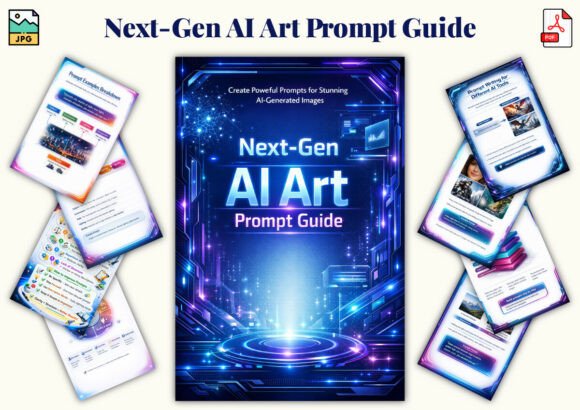
The guide is more than just a collection of tips. It is a 24-page educational ebook designed to take you from absolute beginner to confident prompt architect. Whether you are a designer trying to generate mood boards, a content creator looking for unique visuals, or a digital artist incorporating AI into your workflow, this resource gives you the framework you need to produce consistent, high-quality results.
Understanding How AI Art Prompts Actually Work
To write better prompts, you first need to understand what happens when you type a sentence into an image generator. AI models are trained on millions of images paired with text descriptions. Over time, they learn to associate certain words with visual patterns, colors, compositions, and styles. When you write a prompt, the model interprets your words as a set of signals, and it generates an image that attempts to match those signals as closely as possible.
The problem is that human language is ambiguous. Words like "beautiful," "cool," or "nice" carry different meanings for different people. An AI might interpret "beautiful sunset" in a hundred different ways. That is why the Next-Gen AI Art Prompt Guide places such heavy emphasis on specificity. The guide teaches you how to break down your idea into concrete elements: subject, setting, lighting, mood, color palette, artistic style, and composition. Instead of saying "a futuristic city," you learn to say something like "a sprawling neon-lit futuristic city at dusk, with towering glass skyscrapers, flying vehicles, and rain-slicked streets reflecting purple and blue lights, cinematic lighting, photorealistic." The difference in output is night and day.
What You Will Actually Learn From This Guide
One of the standout features of the guide is how it progresses from foundational concepts to advanced strategies. It does not assume prior knowledge. The first sections cover the anatomy of a prompt: what each part does, how the AI prioritizes different words, and how to structure your sentence for maximum clarity. From there, you move into controlling visual elements like style, lighting, and composition. This is where the guide truly shines for people who have been stuck with inconsistent results.
Controlling Style, Lighting, and Mood
Many users struggle because they do not realize how much influence they have over the aesthetic direction of an image. The guide walks through how to specify an artistic style: impressionist, surrealist, cyberpunk, minimalist, baroque, anime, watercolor, or hyperrealistic, to name just a few. Similarly, it covers lighting terminology that the AI understands: dramatic lighting, soft diffused light, golden hour, volumetric lighting, rim light, and so on. Once you learn to combine style and lighting with a mood descriptor like "melancholic," "serene," "chaotic," or "mysterious," your images start to feel intentional rather than random.
Advanced Strategies for Prompt Layering and Optimization
For those who already have some experience, the guide includes advanced techniques like prompt layering. This is the practice of building a prompt in stages, refining each aspect before moving to the next. You might start with the subject, then add the environment, then adjust the lighting, then layer in a stylistic reference, and finally tweak the color palette. The guide explains how to test each layer independently so that you can identify what is working and what is not. This methodical approach saves time and reduces the frustration of generating dozens of images without getting the right result.
Why Consistency Matters in Creative Work
If you are using AI art for professional purposes, consistency is likely one of your biggest pain points. It can be difficult to generate multiple images that feel cohesive, especially if you need a series of visuals for a brand, a storyboard, or a product launch. The Next-Gen AI Art Prompt Guide addresses this directly by showing you how to create prompt templates that you can reuse and adapt. Once you develop a prompt structure that works for a certain style or mood, you can swap out the subject while keeping the rest of the instructions intact. This is how professionals maintain a consistent visual identity across their AI-generated work.
The guide includes a practice worksheet that helps you build your own prompts from scratch. This is not just theoretical. You are actively writing, adjusting, and refining as you go. For anyone who learns by doing, this worksheet alone is worth the investment. It turns abstract advice into a hands-on exercise that builds real skill.
Common Mistakes and How the Guide Helps You Avoid Them
Even experienced AI users fall into certain traps. One of the most common is overloading the prompt with too many conflicting ideas. When you try to combine multiple styles, subjects, and moods without a clear hierarchy, the AI produces a muddled image that tries to do everything at once. The guide teaches you how to prioritize and trim. Another frequent mistake is neglecting negative prompts or exclusionary language. If you do not tell the AI what to avoid, you might get unwanted elements like extra limbs, distorted faces, or background clutter. The guide explains how to phrase negative instructions in a way that the models reliably understand.
There is also the issue of burnout from generating too many images without a clear goal. The guide encourages intentional prompt writing. Instead of typing random sentences and hoping for the best, you learn to approach each generation with a specific outcome in mind. This not only improves your results but also makes the entire process more enjoyable and less wasteful.
Who Benefits Most From This Resource
While the guide is designed to be accessible to beginners, it carries significant value for intermediate and advanced users as well. If you have been generating AI art for a while but feel like you have hit a plateau, the structured framework can help you break through. The techniques for prompt layering, style control, and optimization are exactly the kind of skills that separate casual users from those who consistently produce portfolio-worthy work.
For content creators, the guide offers a faster path to generating visuals that match a brand or aesthetic. For digital artists, it provides a way to integrate AI into your existing workflow without sacrificing artistic control. For beginners, it removes the guesswork and replaces it with a clear, teachable process. The files are provided as a high-quality PDF along with JPG images of every page, and the format is a standard 6 × 9 inches, making it easy to read on any device or print for reference.
Integrating the Guide Into Your Modern Workflow
AI art generation is no longer a niche hobby. It has become a standard tool in advertising, publishing, game development, film pre-visualization, social media content, and product design. The Next-Gen AI Art Prompt Guide fits naturally into this modern workflow because it does not focus on any single software or platform. The principles apply equally to Midjourney, DALL·E 3, Stable Diffusion, Leonardo AI, and others. Once you understand how to structure a prompt, you can adapt your approach to any tool.
Consider a typical scenario for a social media manager. You need a series of images for a campaign about a new product launch. You want each image to feel cohesive, with consistent lighting, color grading, and aesthetic. Without a solid prompting strategy, you might end up with images that look like they belong to different campaigns. Using the techniques in the guide, you can create a master prompt framework that you replicate for each image, adjusting only the product placement and background details. The result is a unified set of visuals that looks professional and deliberate.
For independent artists and designers, the guide opens up new avenues for experimentation. You can explore styles you have never tried before, simply by understanding the vocabulary that activates those styles. You can combine photographic realism with surrealist elements, or blend traditional painting techniques with futuristic themes. The guide gives you the language to do that consistently.
Final Observations on Prompt Mastery
AI art is still evolving, but the fundamentals of prompt writing are becoming clearer with each generation of models. The gap between a mediocre prompt and an excellent one often comes down to structure, specificity, and an understanding of how the model interprets language. The Next-Gen AI Art Prompt Guide distills these fundamentals into a format that is easy to digest, practical to apply, and comprehensive enough to grow with you as your skills improve.
Whether you are just starting out or looking to refine your existing process, this guide offers a clear path forward. It teaches you not just what to write, but why certain phrases work and others do not. It encourages experimentation while providing guardrails that prevent frustration. And it equips you with a repeatable method for generating images that consistently meet your creative vision. In a field where the technology changes rapidly, having a solid foundational understanding of prompting is one skill that will never become obsolete.