Unlocking Deep Concentration with 1000 Prompts for Better Focus
In an era where notifications, multitasking, and information overload compete for every second of your attention, the ability to concentrate has become a rare and valuable skill. Many professionals, creators, and students find themselves trapped in cycles of distraction, struggling to complete meaningful work. While countless productivity books and apps promise solutions, few offer a structured, repeatable method for actually training the mind to focus. 1000 Prompts for Better Focus addresses this gap directly, providing a comprehensive system that goes beyond simple advice to deliver actionable, scenario-specific guidance for regaining control over your attention.
The Architecture of a Focus System
What distinguishes a collection of prompts from a true productivity system is the underlying organization and intentional design. 1000 Prompts for Better Focus is structured around six core pillars that together form a complete approach to concentration and efficiency. Each pillar targets a specific dimension of focus, allowing users to address their unique challenges methodically.
Attention and Discipline Foundations
The first major category within the collection focuses on building the fundamental skills of sustained attention. These prompts are designed to help you recognize when your mind begins to wander and gently guide it back to the task at hand. Rather than treating distraction as a failure, the prompts reframe it as a signal—an opportunity to strengthen your mental muscles. For example, a prompt might ask you to identify the exact moment your focus broke during a work session and analyze what triggered the shift. Over time, this awareness becomes automatic, reducing the frequency and duration of interruptions.
Environmental and Digital Hygiene
External factors play an enormous role in determining whether you can concentrate deeply. This section of the collection provides targeted prompts for auditing your physical workspace and digital ecosystem. Users are guided to evaluate their notification settings, browser tab habits, and even the ergonomics of their desk setup. One prompt might challenge you to remove three unnecessary apps from your phone, while another asks you to map the physical flow of your workspace and identify friction points. The result is a personalized environment optimized for sustained attention.
Practical Applications Across Professions
The versatility of 1000 Prompts for Better Focus becomes apparent when you consider how different user groups can integrate the prompts into their daily routines. The system is not prescriptive in a one-size-fits-all sense; rather, it offers adaptable pathways that respect the diversity of modern work and life.
For Creators and Knowledge Workers
Writers, designers, programmers, and researchers often need extended periods of uninterrupted time to produce their best work. The deep work and mental clarity prompts within the collection are particularly valuable here. A software developer, for instance, might use a prompt to identify the single most important task for the day before opening any code editor, then use another prompt to review how many context switches occurred during the first hour of work. Over weeks, this practice builds a habit of deliberate task selection and sustained immersion.
Consider a freelance graphic designer juggling multiple client projects. The time management and productivity prompts help this professional break down large deliverables into focused sprints, while the discipline and consistency prompts provide the structure needed to maintain momentum even when client feedback is delayed or ambiguous. The prompts act as a personal accountability partner, asking questions that reveal hidden bottlenecks and mental blocks.
For Educators and Researchers
Academic professionals face unique focus challenges, from grading stacks of assignments to conducting literature reviews that require sustained cognitive engagement. The mindfulness and focus training prompts offer techniques for returning to the present moment when the mind drifts toward administrative worries or future deadlines. A researcher preparing a manuscript might use a prompt to define the specific question they want to answer before opening a single source, then later use a reflection prompt to assess whether their reading stayed aligned with that question.
The collection also supports collaborative environments. Team leaders can adapt certain prompts for group discussions, asking each member to share one strategy for reducing meeting distractions. This turns the prompts from a personal tool into a shared language for building a culture of focused work within an organization.
For Hobbyists and Lifelong Learners
Not all focus challenges are professional. Anyone learning a new skill—whether playing an instrument, studying a language, or mastering a craft—benefits from the structured attention that the prompts encourage. A person practicing piano, for example, might use a prompt to set a specific intention for a practice session rather than simply repeating pieces aimlessly. Another prompt might guide them to reflect on which distractions consistently disrupt their practice time and develop a countermeasure.
Core Strengths of the Prompt-Based Approach
The design philosophy behind 1000 Prompts for Better Focus rests on several key advantages over traditional productivity methods.
- Active engagement over passive reading: Unlike a typical self-help book that you read once and forget, each prompt demands an active response—writing, reflecting, or taking a concrete action. This creates a feedback loop that reinforces learning and habit formation.
- Scalable difficulty: Beginners can start with foundational prompts about basic awareness, while experienced practitioners can tackle advanced prompts that challenge their assumptions about time management and mental stamina. The same collection grows with you.
- Reusability: Because attention challenges recur in different forms, the prompts remain relevant across months and years. A prompt about managing digital distractions will yield different insights each time you revisit it, as your environment and habits evolve.
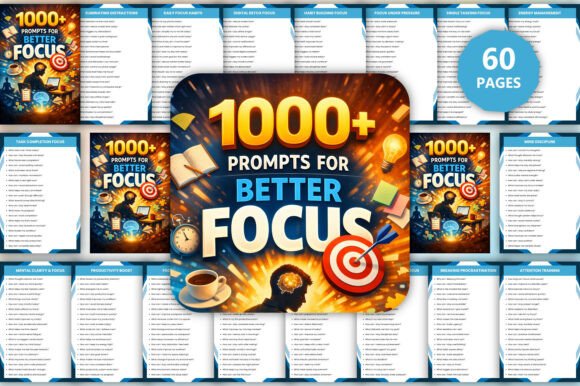
- Portable and flexible formats: The included high-quality PDF and JPG files allow you to use the prompts in whatever medium works best—printing for a physical journal, loading onto a tablet for digital annotation, or displaying on a secondary screen during work sessions. The 6×9 inch page size fits standard notebooks and binders, making it easy to integrate into existing organizational systems.
Integrating the Prompts into Daily Workflows
Adopting a system of 1000 prompts does not require a complete overhaul of your routine. In fact, the most effective implementation is gradual and adaptive. Here are several observed approaches that users have found successful.
Morning Anchor Practice
One common pattern is to begin each day with a single prompt from the motivation and consistency category. The prompt might ask you to define one non-negotiable outcome for the day, or to visualize how you will handle a specific distraction that typically derails your afternoon. This sets a clear intention before the chaos of the day begins. The act of writing the response—even just a few sentences—activates cognitive commitment and primes the brain to protect that priority.
End-of-Day Reflection Loop
Evening prompts from the mindfulness and mental clarity section help consolidate the day's learning. A prompt might guide you to review three moments when you lost focus, identify the common thread, and propose one small change for tomorrow. Over time, this reflection transforms sporadic awareness into systematic improvement. Users report that this nightly practice reduces the feeling of being stuck in the same distraction patterns week after week.
Deep Work Preparation Sessions
Before entering a period of intensive cognitive work, selecting prompts from the deep work and time management categories can dramatically improve outcome quality. For example, a prompt might ask you to define the specific deliverable for the next ninety minutes, list three potential interruptions and how you will neutralize them, and set a single measurable goal for the session. This ritual signals to your brain that it is time to shift into a focused state, much like a athlete's pre-performance routine.
Practical Considerations and Usage Tips
Getting the most out of 1000 Prompts for Better Focus requires attention to a few practical details that enhance long-term engagement.
First, resist the urge to consume prompts rapidly. The collection is designed for depth, not speed. Spending fifteen minutes on a single prompt and honestly answering its questions yields far more value than skimming through twenty prompts superficially. Treat each prompt as a micro-coaching session with yourself.
Second, consider pairing the prompts with a consistent time and place. The professional who uses the same coffee shop table each morning and the student who sits at the same library desk both report that environmental context strengthens the prompt's effect. The brain begins to associate that location with focused self-reflection, reducing resistance over time.
Third, the physical formats matter for different use cases. The printable PDF files are ideal for those who prefer handwriting—a process that enhances cognitive processing and memory retention. The JPG images work well for digital note-taking apps, allowing users to annotate directly on the prompt and store responses in searchable folders. Having both options ensures that the system fits into your existing workflow rather than forcing you to adapt to the tool.
Finally, rotation prevents staleness. Because the prompts are organized thematically, you can cycle between categories weekly. One week might focus on distraction control and digital detox, while the next emphasizes time management and productivity planning. This variety keeps the practice fresh and ensures all dimensions of your focus capacity develop in balance.
Real-World Outcomes and Observations
Users who engage consistently with the prompts report several measurable changes in their work and life quality. The most commonly cited outcome is a reduction in the time spent in what researchers call "attention residue"—the mental carryover from unfinished tasks that degrades performance on subsequent activities. By using prompts to close tasks mentally and set clear boundaries, individuals experience cleaner transitions between projects.
Another observed benefit is improved emotional regulation around distraction. Rather than reacting with frustration or guilt when focus breaks, practitioners learn to treat interruptions as data points. A prompt that asks "What was the internal or external trigger for this interruption?" transforms a moment of frustration into a moment of insight. Over weeks, this shift reduces the emotional charge around distraction and makes recovery faster.
Professionals in high-pressure environments—such as healthcare, finance, and software engineering—note that the prompts help them maintain composure during chaotic periods. The mindfulness and focus training prompts, in particular, offer techniques for grounding that can be used in real time, even during a busy workday. A nurse manager might use a breathing prompt between patient emergencies, while a trader could use a concentration prompt before executing a complex transaction.
Adapting the System for Teams and Groups
While the individual application is powerful, some groups have adapted the prompts for collective use. A design team might begin each sprint planning meeting with a shared prompt about managing collaborative distractions, then discuss their answers briefly to align on focus norms. A research lab could use prompts from the mental clarity section before data analysis sessions to ensure everyone enters the work with a clear question in mind.
This collaborative dimension adds accountability and shared vocabulary. When team members can say "I need to use a focus prompt before I tackle this" or "My distraction pattern this week has been email checking during coding," they normalize the struggle and make improvement a collective goal. The prompts become a framework for team culture, not just individual productivity.
Sustaining Long-Term Engagement
Any tool's value ultimately depends on sustained use, and 1000 Prompts for Better Focus is designed with longevity in mind. The sheer variety of prompts—spanning mindset, discipline, deep work, mindfulness, time management, and distraction control—ensures that users rarely encounter repetition. Even when revisiting a category, the prompts are nuanced enough to reveal new insights as your skills develop.
Users who maintain a simple tracking system—such as a checkmark next to completed prompts with a date and a one-word reflection—report feeling a sense of progress that motivates continued practice. The collection's 60 beautifully designed pages also provide aesthetic satisfaction, making the act of engaging with the prompts feel like a deliberate ritual rather than another chore.
For those who worry about completing all 1000 prompts, it is helpful to reframe the goal. The system is not a checklist to finish but a library to draw from indefinitely. You could use 300 prompts in the first year, return to old favorites when facing familiar challenges, and still have hundreds of unexplored prompts waiting for when you need a fresh perspective. The collection's depth ensures that your focus practice never hits a plateau.
Ultimately, the measure of success with 1000 Prompts for Better Focus is not how many prompts you complete, but whether your relationship with attention and productivity has shifted. When you find yourself naturally pausing before reacting to a notification, setting clearer priorities without external prompting, and recovering more quickly from interruptions, the system has done its work. The prompts are training wheels for a skill that gradually becomes second nature—and that is the truest sign of a well-designed focus system.