Why Traditional Cleaning Systems Fail the ADHD Brain—and What Actually Works
If you have ADHD, you already know the cycle. You see a messy kitchen. You feel a surge of motivation. You tell yourself, “Today is the day I finally get this place spotless.” Twenty minutes later, you’re sitting on the floor surrounded by half-sorted piles, scrolling your phone, and wondering where your energy went. The problem isn’t laziness. The problem is that most cleaning advice was written for neurotypical brains. It assumes linear thinking, consistent motivation, and the ability to prioritize without getting derailed. That’s why an ADHD Cleaning Routine Builder exists—not to push you harder, but to work with the way your brain actually operates.
The Fundamental Flaw in Standard Cleaning Advice
Conventional cleaning systems rely on a few unspoken assumptions. They assume you can look at a messy room and intuitively know where to start. They assume you can maintain focus for an hour without becoming bored or overwhelmed. And they assume that if you just try harder, you’ll develop a habit within twenty-one days. For someone with executive dysfunction, each of those assumptions is a trap. The result isn’t a clean home—it’s shame, guilt, and a growing pile of unfinished tasks.
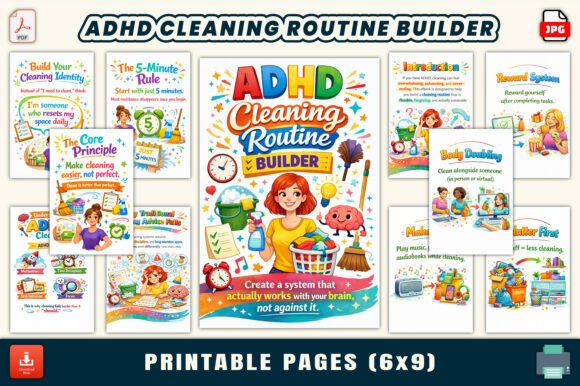
This is where the ADHD Cleaning Routine Builder fundamentally differs. Instead of demanding perfection or rigid schedules, it acknowledges that your motivation fluctuates. It offers strategies that adapt to your mental state, not the other way around. The 🧠 ADHD Cleaning Routine Builder 30-Page Printable eBook JPG PDF 6×9 Inches is one example of a tool that translates this philosophy into a practical format. It doesn’t tell you to clean for two hours every Saturday. It gives you permission to do five minutes and call it a win.
Understanding Executive Dysfunction in the Context of Cleaning
Executive dysfunction affects several cognitive processes that are crucial for cleaning. Task initiation is often the hardest part—you know the dishes need to be done, but you can’t make yourself stand up and start. Task switching is another challenge: once you’re in the middle of cleaning the living room, moving to the bathroom feels like climbing a mountain. Working memory also plays a role. You walk into the kitchen to put away groceries, get distracted by a spill, wipe the counter, notice the trash is full, take out the trash, and then forget the groceries entirely.
A good ADHD Cleaning Routine Builder compensates for these challenges by breaking cleaning into micro-tasks. It uses external cues—like checklists, timers, and visual progress indicators—so your brain doesn’t have to hold everything in memory at once. The 30-page printable format of this specific eBook allows you to have those cues physically in front of you, which reduces cognitive load. When your brain doesn’t have to decide what to do next, it can actually execute the task.
The Psychology Behind the 5-Minute Rule
One of the most effective techniques in any ADHD-friendly cleaning system is the 5-Minute Rule. The concept is simple: you commit to cleaning for exactly five minutes. That’s it. You can stop after five minutes, no guilt allowed. The genius of this approach is that it bypasses the resistance your brain builds against large tasks. Starting is the hardest part, and five minutes is short enough that your brain doesn’t perceive it as a threat.
In practice, what often happens is that after five minutes, you’re already in motion. The hardest part—getting started—is behind you. Many people find that they continue for ten or fifteen minutes once the initial barrier is broken. The ADHD Cleaning Routine Builder incorporates this principle throughout its pages, with dedicated prompts and timers that turn the five-minute sprint into a sustainable habit. The printable PDF and JPG files, formatted at 6×9 inches, make it easy to keep a copy on your counter or fridge as a constant visual reminder.
Zone Cleaning: Reducing Overwhelm Through Physical Boundaries
Another core feature of this system is the zone cleaning approach. Instead of trying to clean the entire house—which is overwhelming for anyone, let alone someone with ADHD—you break it down by zones. A zone might be the kitchen sink area. Another zone might be the coffee table. By limiting your focus to a small, defined space, you eliminate the decision paralysis that comes from facing a whole room.
The 🧠 ADHD Cleaning Routine Builder 30-Page Printable eBook provides templates for mapping out your zones, so you don’t have to design a system from scratch. You can assign a zone to each day of the week, or you can work through zones in whatever order feels right. The key is that each zone is small enough to be completed in one focused session—usually under fifteen minutes. This structure also plays into the dopamine reward system. Finishing a zone gives you a small but genuine sense of accomplishment, which encourages you to tackle the next one.
Daily and Weekly Routines That Actually Account for ADHD
Many pre-made cleaning routines assume you have consistent energy every day. They list tasks like “dust all surfaces” and “mop kitchen floor” without considering that some days you can barely get out of bed. The routines included in this builder are designed with flexibility. Daily tasks are minimal—things like making the bed or wiping down one counter. Weekly tasks are grouped into categories, and you’re encouraged to pick and choose based on how you’re feeling.
Importantly, the system includes a “good enough” mindset as a core principle. This isn’t about lowering your standards—it’s about recognizing that perfectly cleaned is not the same as functionally clean. A home that is tidy enough to find your keys and cook dinner is a success. The printable pages include affirmations and reminders that help reinforce this perspective, which is crucial for people who tend toward all-or-nothing thinking.
Decluttering Methods to Reduce the Cleaning Load
Cleaning is infinitely harder when every surface is cluttered. Clutter creates visual noise, which is particularly distracting for ADHD brains. The more stuff you own, the more time you spend moving it around before you can actually clean. That’s why this ADHD Cleaning Routine Builder includes dedicated decluttering methods that are specifically adapted for neurodivergent people.
One approach is the one-touch rule for paper and small items: pick it up once, decide immediately whether to keep, toss, or put it away. Another method is the four-box system: keep, donate, trash, and relocate. Instead of trying to declutter an entire room in a weekend—which leads to burnout—the builder encourages you to declutter for ten minutes at a time, using checklists that prevent you from going down rabbit holes. Over weeks and months, this gradual reduction in clutter makes your daily cleaning routine significantly easier.
Overcoming Procrastination with Motivation Hacks
Motivation is not a character flaw—it’s a neurochemical state that can be influenced by external factors. The eBook outlines several motivation hacks that are grounded in behavioral psychology. Body doubling is one of the most effective. This is where you work alongside another person—even virtually—who is also doing a task. The presence of another person, even if they aren’t actively helping, reduces the feeling of isolation and increases accountability.
Reward pairing is another strategy. You pair a less enjoyable task (like scrubbing the toilet) with a small reward (like listening to a favorite podcast or allowing yourself a treat afterward). The ADHD Cleaning Routine Builder includes prompts to help you identify your own rewards and build them into your cleaning sessions. Over time, your brain starts to associate cleaning with positive outcomes rather than dread.
The Emergency Cleaning Routine for Overwhelming Days
Even with the best systems, there will be days when everything falls apart. You have guests arriving in thirty minutes, or you’ve let things slide for two weeks, and the mess feels insurmountable. The quick emergency cleaning routine in this eBook is designed for exactly those moments. It’s a stripped-down, high-impact sequence that focuses only on visible surfaces, trash removal, and odor control. You don’t organize—you hide and toss.
The emergency routine is intentionally short, often under fifteen minutes. It prioritizes the spaces your guests will actually see and ignores everything else. This prevents the paralysis that comes from trying to fix everything at once. Having this routine saved in a printable format means you can grab it without having to think. When executive function is at its lowest, a checklist you can follow blindly is a lifeline.
Why Physical Printables Work Better Than Apps for Many ADHD Brains
Digital tools have their place, but many people with ADHD find that physical printed materials reduce screen fatigue and provide a tactile sense of progress. The 30-page JPG and PDF format at 6×9 inches is designed to be printed at home or at a print shop, then kept in a binder, notebook, or on a clipboard. Crossing items off with a pen creates a physical marker of completion that a digital checkbox often lacks.
Furthermore, printed pages don’t have notifications, pop-ups, or the temptation to open another app. They exist in your physical space as a dedicated tool. The clean, minimal layout of this eBook is intentionally low-stimulus—no distracting graphics or overwhelming colors—which helps keep focus exactly where it needs to be.
Practical Considerations Before You Start
If you’re considering using an ADHD Cleaning Routine Builder, here are a few recommendations based on common experiences. First, don’t try to implement every strategy at once. Pick two or three tools—maybe the zone cleaning and the 5-Minute Rule—and use them consistently for two weeks before adding anything else. Second, lower your expectation for what “following the routine” looks like. If you use it two out of seven days, that’s progress. Consistency comes from showing up imperfectly, not from being perfect.
Third, involve an accountability partner if possible. Share your progress with a friend, partner, or online community. The body doubling principle works just as well for routine building as it does for the cleaning itself. Finally, give yourself permission to modify the system. The eBook is a starting point, not a rigid prescription. If a particular method doesn’t work for you, ignore it and try another.
Long-Term Habit Building Without the Burnout
The ultimate goal of any ADHD-friendly cleaning system is not a spotless home—it’s a home that supports your well-being without draining your mental energy. The 🧠 ADHD Cleaning Routine Builder 30-Page Printable eBook JPG PDF 6×9 Inches is a tool that helps bridge the gap between intention and action. It acknowledges that your brain works differently and gives you a framework that works with, not against, your natural tendencies.
Over time, the routines you build will become automatic. The zone cleaning will turn into a habit. The five-minute timer will feel less like a chore and more like a manageable commitment. The clutter will decrease, and so will the mental load. What remains is a living space that feels like a sanctuary rather than a source of guilt. And that shift—from cleaning as a burden to cleaning as a manageable part of your life—is the true purpose of this system.