End of Year Learning Awards Workbook
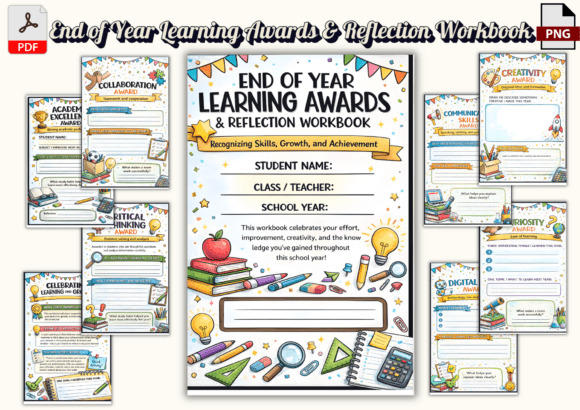
Closing out a school year offers a rare window for genuine reflection, yet most approaches to capturing student growth feel rushed or superficial. The End of Year Learning Awards Workbook changes that dynamic entirely. Instead of a generic recap, this 19-page printable resource turns the end-of-year review into a structured, celebratory process that students can own. Designed around specific achievement categories—from critical thinking and collaboration to persistence and digital skills—the workbook gives educators and parents a concrete tool for helping students see how far they have come.
What makes this workbook strategically useful is not just its content but its deliberate design. Each page targets a distinct competency, such as scientific thinking or mathematical reasoning, and pairs it with guided reflection prompts. Students write, draw, and assess their own progress, which builds self-awareness far more effectively than a teacher-led summary. For educators, homeschool instructors, and even entrepreneurs who run learning programs or tutoring businesses, the workbook serves as both a record-keeping asset and a motivational device. It documents growth in a format that students and families can revisit, reinforcing the value of the learning journey rather than just the final grade.
Why Thoughtful Reflection Matters for Long-Term Learning Outcomes
Research consistently shows that structured reflection improves retention and deepens understanding. Yet many end-of-year rituals miss this opportunity. The End of Year Learning Awards Workbook embeds reflection into every page, which means students are not passively receiving recognition—they are actively constructing their own learning narrative. When a student writes about how they demonstrated creativity or leadership, they internalize those behaviors as repeatable skills. This shifts their identity from “someone who completed assignments” to “someone who thinks critically and collaborates effectively.”
For educators and program leaders, this distinction matters. A student who sees themselves as a persistent problem-solver is more likely to tackle difficult material the following year. The workbook essentially builds a psychological bridge between past effort and future capability. It also provides parents with a concrete artifact they can discuss with their child, turning a single workbook into a conversation starter about growth, effort, and next steps.
Strategic Use Cases Across Different Learning Environments
The flexibility of the End of Year Learning Awards Workbook makes it applicable in more settings than a traditional classroom. Consider a homeschool parent managing multiple children across different grade levels. The 6 x 9 inch printable format means each child gets their own personalized workbook, and the award categories remain consistent regardless of subject matter. The parent can use the same prompts for a third grader learning multiplication and a middle schooler studying algebra, adjusting the depth of conversation without changing the structure.
For small business owners who run after-school programs, tutoring centers, or enrichment workshops, the workbook doubles as a client retention tool. Distributing these workbooks during the last session of the year gives families a tangible takeaway that demonstrates the program’s impact. It also opens a natural conversation about re-enrollment, because parents can see exactly which skills their child developed. The Future Goals page is particularly effective here, as it positions the upcoming year as a continuation of growth rather than a restart.
Independent education consultants and bloggers can also use the workbook as a lead magnet or free resource for their audience. By offering the End of Year Learning Awards Reflection Workbook Printable Student Reflection Achievement Book as a download, they build credibility while providing immediate value. Parents and educators searching for end-of-year activities will find the format both practical and emotionally resonant, which increases the likelihood of sharing it with their networks.
Planning Your Approach: When and How to Use the Workbook
Timing matters more than most people assume. The workbook works best when introduced during the final two to three weeks of the academic term, not on the last day. Spreading the 19 pages across several sessions prevents reflection fatigue and allows students to think carefully about each category. A practical schedule might involve completing two to three award pages per day, followed by a brief group discussion or one-on-one check-in. This pacing transforms the workbook from a worksheet into a ritual.
Before distributing the workbook, consider how you will frame the activity. Students who are used to grades and external evaluation may initially treat the prompts as a test rather than a reflection. A brief explanation upfront—that the goal is to recognize their own growth, not to earn a score—sets the right tone. You might also complete a sample page together as a group, modeling how to think through each prompt. For younger students or those who struggle with writing, the draw option on each page provides an alternative pathway for expression.
Another planning consideration is how you will handle the certificate at the end. The Final Learning Certificate should feel like a genuine milestone. Consider adding a small ceremony, a signature line for the teacher or parent, and a space for a personal note. This elevates the entire workbook from a series of worksheets to a keepsake that students will hold onto for years.
What to Consider Before Adopting the Workbook
No tool works in every context, and the End of Year Learning Awards Workbook is no exception. The workbook assumes a certain level of reading and writing ability, which means it may need adaptation for very young students or those with language delays. In those cases, you can use the pages as conversation guides rather than independent writing activities. Sit with the student, ask the prompts verbally, and record their answers yourself. The reflection still happens, just with more scaffolding.
Another consideration is the risk of turning reflection into a compliance task. If students feel pressured to produce the “right” answers or if the workbook is graded, the reflective value disappears. The workbook works best when treated as a low-stakes, high-meaning activity. Emphasize honesty over polish, and celebrate genuine self-assessment even when a student acknowledges areas where they struggled. The Growth Mindset and Persistence pages are specifically designed to normalize challenges as part of learning, so lean into those sections when students express frustration or disappointment.
There is also a practical consideration around distribution. The 6 x 9 inch format is intentionally compact, but it still requires printing for physical use. If you are in a setting with limited printing resources, consider using the PNG image files on a tablet or computer with a drawing app. Students can type or draw digitally, and you can compile the pages into a single PDF at the end. This approach also works well for online tutoring or virtual classrooms where physical handouts are not feasible.
Decision-Making Guidance: How to Choose the Right Approach for Your Setting
Selecting whether to use the workbook as a printed booklet, a digital assignment, or a guided conversation depends on your primary goal. If your objective is to create a lasting keepsake that families can keep, printing and binding the pages into a small booklet is the best route. The tactile experience of flipping through completed pages, seeing drawings and written responses, has an emotional weight that digital files cannot replicate.
If your goal is efficiency and scalability—for instance, if you run a tutoring center with dozens of students—digital delivery with a single PDF upload might be more practical. You can still encourage families to print at home, but the digital version allows for quick distribution and easy storage. The PNG image files also let you insert individual pages into a learning management system or email them as separate attachments for focused assignments.
For educators who prioritize discussion over documentation, the workbook can serve as a conversation framework. Use the award categories as discussion prompts during a group circle, then have students complete one or two pages afterward to capture their key takeaways. This hybrid approach balances verbal reflection with written record, meeting the needs of both extroverted and introverted learners.
Long-Term Value Beyond the Current School Year
The most underappreciated advantage of the End of Year Learning Awards Workbook is its archival value. When students complete the workbook each year, they create a longitudinal record of their growth. A sixth grader who looks back at their fifth-grade workbook can see concrete evidence of how their mathematical thinking, communication skills, and leadership abilities have developed. This is far more motivating than a report card, because it connects growth to specific behaviors and mindsets rather than abstract numbers.
For parents, these workbooks become a portfolio of their child’s educational journey. They document not just what the child learned, but how the child experienced learning. The Positive Classroom Impact page, for example, captures moments of kindness and contribution that might otherwise be forgotten. Years later, these pages serve as a narrative of character development, not just academic progress.
For educators and program leaders, collecting these workbooks over multiple years provides valuable insights into how your curriculum or teaching approach influences different types of growth. You might notice that students consistently rate themselves lower on Creativity but higher on Collaboration, prompting you to adjust your lesson design. The workbook becomes a feedback loop for your own practice, helping you make more intentional decisions about how you structure learning experiences.
Practical Tips for Maximizing Engagement and Impact
Getting the most out of the workbook requires more than just handing it out. Here are several approaches that experienced educators and program leaders have found effective:
- Start with the Future Goals page as a preview. Let students see the final page first so they understand the arc of the workbook. This creates anticipation and gives them a destination to work toward.
- Use the award categories as a vocabulary lesson. Before students write, discuss what terms like “persistence” or “scientific thinking” actually mean. Provide examples from the school year that illustrate each concept. This builds both literacy and clarity.
- Pair students for peer interviews. Instead of writing alone, have students interview each other using the prompts. One student records the other’s answers, then they switch roles. This adds a social dimension that many students find more engaging than solo writing.
- Connect each award to a specific moment. When a student writes about collaboration, ask them to recall one project or activity where they worked well with others. Anchoring reflection to concrete memories makes the recognition feel real rather than generic.
- Set a celebratory tone throughout. Play background music, allow flexible seating, or provide small snacks while students work. The physical environment signals that this activity is different from regular assignments—it is a celebration of their growth.
Risks of Using the Workbook Without Clear Intentions
The primary risk of any reflection tool is that it becomes an empty exercise. If you distribute the End of Year Learning Awards Workbook without explaining its purpose, students will treat it as busywork. The pages will be filled with vague, rushed answers, and the potential for genuine insight will be lost. To avoid this, invest time in framing the activity. Explain that this is not about grades or comparison—it is about recognizing their own journey. Your tone sets the standard.
Another risk is overloading students. Nineteen pages can feel overwhelming if presented all at once. Break the workbook into manageable chunks, and do not require every page to be completed in a single sitting. Allow students to skip a category if they feel they have nothing to say about it. Forcing answers undermines the authenticity of the reflection.
There is also a subtle risk around equity. Students who struggle with writing or who have had a difficult year may feel that the workbook highlights their shortcomings rather than their growth. The Future Goals page helps mitigate this by orienting attention toward what is possible, but you should be prepared to offer one-on-one support for students who find the process emotionally challenging. The workbook is a tool for celebration, not judgment, and your facilitation determines whether that message lands.
Integrating the Workbook Into a Broader End-of-Year Strategy
The End of Year Learning Awards Reflection Workbook Printable Student Reflection Achievement Book fits naturally into a larger end-of-year plan. Pair it with a portfolio review where students select their best work from the year, then use the workbook to articulate why that work matters. Combine it with a parent-teacher conference where the workbook guides the conversation, turning it from a score report into a narrative of growth. Use it as a foundation for a class presentation or a digital slide deck that students share with their families.
For entrepreneurs and small business owners in the education space, the workbook can anchor a year-end email sequence or a social media campaign. Share photos of completed pages (with permission), post quotes from student reflections, or offer the workbook as a free download to build your email list. The visual format and celebratory tone make it highly shareable content that resonates with parents and educators alike.
The workbook also supports long-term planning. When students articulate their future goals on the final page, they give you a roadmap for the next year. A student who writes “I want to get better at explaining my ideas” is signaling a need for communication-focused instruction. A student who says “I want to lead a group project” is ready for more responsibility. Capturing these intentions at the end of the year allows you to design the next year’s curriculum with greater precision.
Making the Workbook a Lasting Tradition
The greatest value of the End of Year Learning Awards Workbook emerges when it becomes a recurring practice. Students who complete the workbook year after year build a collection of self-assessments that document not just what they learned, but who they were becoming. The categories stay consistent, which means students can directly compare their growth across years. A high school senior who reviews their middle school workbooks will see a clear trajectory of increasing maturity, skill, and self-awareness.
For educators, establishing this as an annual tradition creates a shared language around growth. New students entering your classroom or program will hear about the workbook from returning students, building anticipation and cultural momentum. The workbook stops being an activity and starts being a rite of passage—a meaningful closure to the learning year that students genuinely look forward to.
When used with intention, the workbook is not just a reflection tool. It is a decision-making instrument that helps students, parents, and educators see learning as a continuous, evolving process. It turns the end of the year into a beginning, planting seeds for the growth that comes next.