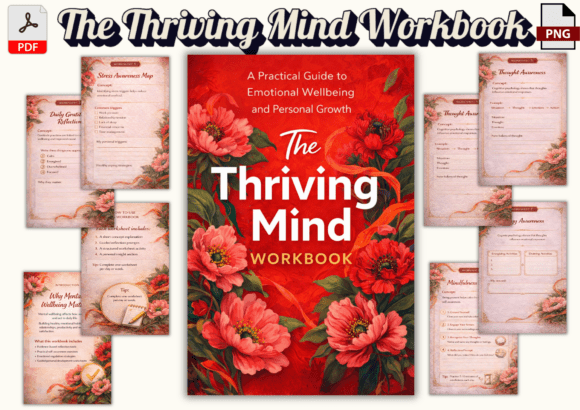
The Thriving Mind Workbook: A Practical Tool for Daily Emotional Resilience
For anyone navigating the demands of work, relationships, and personal growth, keeping a steady mental footing is rarely a passive process. It requires intentional effort, structured reflection, and tools that fit into real-world routines—not just aspirational ideals. The Thriving Mind Workbook enters this space as a focused resource designed to bridge the gap between wanting to build emotional resilience and actually doing it. This 13-page guided journal, available in both printable and digital formats, offers a compact but substantive approach to self-awareness, stress management, and habit formation.
Unlike many self-guided resources that lean heavily on abstract concepts or generic prompts, this workbook grounds its exercises in everyday applicability. The design choices—a 6x9 inch vertical layout, thoughtfully arranged pages, and calming visual structure—are not afterthoughts. They reflect an understanding that consistency in journaling often depends on how easy it is to return to the material. Whether you are a professional managing a packed schedule, a creator balancing multiple projects, or an educator supporting your own wellbeing alongside others, the practicality of this workbook merits a closer look.
Structure and Design: Built for Consistency
One of the first things worth noting about The Thriving Mind Workbook is its deliberate format. At 13 pages, it avoids the common pitfall of overwhelming users with excessive content before they have established a rhythm. Each page is structured around a specific function—emotional check-ins, stress awareness exercises, mindfulness prompts, habit-building worksheets, and goal-tracking sections. This clarity of purpose helps reduce decision fatigue. When you open the workbook, you know exactly what you are working on and why.
The 6x9 inch size is a practical choice. It prints cleanly on standard paper without requiring special trimming or binding, and it also displays well on tablet screens for those who prefer digital use. The vertical orientation aligns naturally with how most people read and write, making it feel less like a form and more like a journal. The visual design is described as calming, which is not merely aesthetic. For a resource focused on emotional regulation, the absence of clutter, aggressive colors, or overcomplicated layouts matters. It allows the content to lead without visual noise competing for attention.
From a usability standpoint, the inclusion of both PDF and PNG formats adds flexibility. You can print the entire workbook for a physical journaling experience, or load individual pages into a note-taking app for repeated use. This dual-format approach accommodates different working styles—some people benefit from the tactile act of writing, while others prefer the convenience of digital storage and searchability.
Core Exercises: Evidence-Based and Actionable
The exercises within The Thriving Mind Workbook focus on several interconnected areas: emotional awareness, stress identification, mindfulness, habit building, self-compassion, and goal tracking. Each section is designed to move the user from passive reflection to active practice. For example, the guided emotional check-ins are not simply open-ended prompts. They encourage users to name specific emotions, note their intensity, and connect them to recent experiences. This structure helps build the skill of emotional labeling, which is widely recognized in cognitive-behavioral approaches as a foundation for regulation.
The stress awareness and coping tools section takes a similar approach. Rather than offering generic advice about reducing stress, it walks users through identifying their personal stress patterns, triggers, and typical responses. This kind of contextual awareness is often more useful than broad relaxation techniques, because it allows for targeted intervention. If you know that certain meetings consistently spike your anxiety, you can prepare ahead rather than react after the fact.
Mindfulness and reflection exercises are integrated throughout, but they are not presented as standalone meditation sessions. Instead, they are woven into the journaling process—short prompts that ask you to pause, observe your current state, and write down what you notice. This keeps mindfulness grounded in daily life rather than reserved for a separate practice.
The habit-building worksheets deserve special mention. They follow a logical sequence: identify a target behavior, define the cues and rewards, track consistency, and adjust based on outcomes. This mirrors the habit loop framework without requiring the user to study the underlying theory. For professionals and entrepreneurs who are already familiar with productivity systems, these sheets provide a quick way to apply structured thinking to personal wellbeing goals.
Practical Value in Real-World Use
Where The Thriving Mind Workbook truly distinguishes itself is in its efficiency. Most pages can be completed in five to fifteen minutes, making it feasible to integrate into a morning routine, midday break, or evening wind-down. This is not a deep-dive therapeutic journal intended for hours of processing. It is a maintenance tool—something you return to regularly to keep your mental habits aligned with your intentions.
For someone managing a high-responsibility role, this efficiency is critical. A freelancer juggling multiple client deadlines, a small business owner making daily operational decisions, or a marketer navigating fast-paced campaign cycles all face the risk of letting self-reflection slip. This workbook lowers the barrier to entry. You do not need to carve out a full hour; five minutes of structured writing can be enough to reset perspective.
Another strength is its suitability for repeated use. The digital format allows you to reuse pages as needed. If you find the habit-tracking sheet particularly useful, you can reload it weekly without repurchasing. The printable format also means you can keep a physical copy at your desk and a digital copy on your tablet, covering different contexts.
Who Benefits Most
While The Thriving Mind Workbook is positioned broadly for personal development, certain groups will likely find it more immediately useful than others. Professionals in high-stress fields—such as educators, healthcare workers, and entrepreneurs—can use it as a structured outlet that does not demand excessive time. Creatives and marketers, who often work in environments where emotional labor is high, may appreciate the self-compassion and reflection prompts as a way to separate personal worth from output.
For individuals who are new to journaling or self-reflection, this workbook provides enough guidance to prevent the "blank page problem" without being prescriptive to the point of feeling restrictive. The prompts are clear but leave room for personal interpretation. For those with more experience in mindfulness or therapeutic journaling, the workbook serves as a lightweight companion rather than a primary resource. It is not designed to replace deeper therapeutic work, but it can support maintenance and consistency between sessions.
Possible Limitations
No resource is universally perfect, and The Thriving Mind Workbook has boundaries worth acknowledging. At 13 pages, it is relatively short. Users looking for an extensive curriculum or a multi-month program may find it insufficient on its own. It works best as a tool for consistent practice rather than a comprehensive course. Additionally, the exercises are designed for independent use. While this is a strength for privacy and flexibility, it also means there is no built-in feedback mechanism or community component. Some users may benefit from pairing this workbook with a coach, therapist, or accountability partner.
The visual design, while calming, may not appeal to everyone. Those who prefer highly minimalist or data-heavy layouts may find the aesthetic either too soft or not detailed enough. However, for its intended purpose—supporting emotional wellbeing through gentle structure—the design aligns well with the content.
Long-Term Value and ROI
Evaluated as a resource for ongoing use, The Thriving Mind Workbook offers solid long-term value primarily through its reusability. Digital formats allow you to return to exercises without consuming additional materials. The printable version is also economical if you have access to a printer. Compared to purchasing multiple guided journals over time, a single download that can be used repeatedly is a practical investment.
The real return, however, comes from the consistency it enables. When a tool is easy to start and easy to continue, the compound effect of small daily practices becomes meaningful. Over weeks and months, the habit of emotional check-ins, stress identification, and goal tracking can shift how you respond to challenges. The workbook does not promise transformation overnight, but it provides a reliable structure for gradual growth.
Final Observations
The Thriving Mind Workbook occupies a specific and useful niche: a concise, well-designed resource for anyone who wants to integrate emotional resilience practices into a busy life without adding complexity. Its strength lies not in novelty or depth, but in accessibility and consistency. For professionals, entrepreneurs, creators, and educators who recognize the importance of mental wellbeing but struggle to maintain a practice, this workbook offers a realistic starting point and a sustainable rhythm.
If you are looking for a tool that respects your time, provides clear guidance, and can adapt to both print and digital workflows, this workbook deserves consideration. It will not do the work for you, but it will make the work easier to begin—and easier to continue.