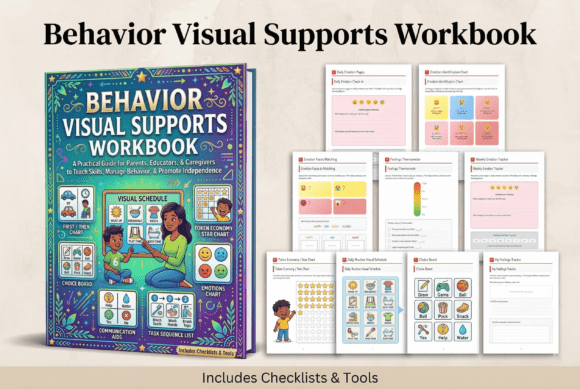
Behavior Visual Supports Workbook – A Practical Tool for Building Routine, Communication, and Emotional Awareness
Supporting positive behavior in children often comes down to one core challenge: helping them understand what is expected, when, and why. For many children—especially those with autism, ADHD, anxiety, or communication delays—verbal instructions alone may not be enough. This is where visual supports can make a meaningful difference. The 🌈Behavior Visual Supports Workbook📚✨ is a 120-page printable resource designed to provide structured, ready-to-use visual tools for parents, teachers, therapists, and caregivers. It aims to reduce frustration, build independence, and make daily routines more predictable. But how does it compare with other approaches to behavior support, and when might it be the right fit for your situation?
What the Behavior Visual Supports Workbook Offers
At its core, this workbook provides a collection of visual aids that help children navigate their day with greater clarity. The pages are designed to be printed and used repeatedly, making them practical for both home and classroom settings. Key components include visual schedule pages for morning, school, and bedtime routines; first–then boards that show what comes first and what comes next; behavior choice boards that offer simple visual options; routine task breakdown pages that break larger tasks into smaller steps; communication support cards for expressing needs and feelings; and emotion feelings charts to support emotional awareness.
What makes this workbook distinct is its focus on being a complete, print-ready system rather than a single tool or app. It consolidates multiple types of visual supports into one resource, which reduces the need to piece together materials from different sources. For caregivers and educators who want a structured, all-in-one solution without designing their own visuals from scratch, this can be a practical time-saver.
Visual Supports vs. Digital Tools and Apps
One common alternative to a printable workbook like this is using digital apps or software that provide visual schedules and behavior charts. Digital tools offer interactivity, sound, and the ability to update content quickly on a tablet or phone. They can be engaging for children who are drawn to screens and may offer tracking features that let you monitor progress over time.
However, digital tools also come with tradeoffs. Screen time can be a distraction for some children, and not every setting allows for tablet or phone use. A printable workbook like the 🌈Behavior Visual Supports Workbook📚✨ offers a tactile, screen-free option that can be posted on a wall, placed on a desk, or carried in a bag. It does not require Wi-Fi, battery charging, or troubleshooting technical issues. For children who benefit from physical manipulatives—such as moving a card from one spot to another—paper-based visuals can be more direct and less abstract than a digital interface.
That said, digital tools may be a better fit for families who already rely on tablets for learning, or for children who are highly motivated by interactive rewards and gamified progress tracking. The decision often comes down to whether you prefer a low-tech, always-available resource or a more dynamic, interactive platform.
How This Workbook Compares with DIY Visual Supports
Many parents and teachers create their own visual supports using clip art, photos, or simple drawings. This approach allows for complete customization—you can tailor every image to your child's specific routines, preferences, and environment. DIY visuals can be deeply personal and may include real photos of the child's own bedroom, classroom, or family members, which can increase engagement and recognition.
The 🌈Behavior Visual Supports Workbook📚✨ offers a middle ground. It provides professionally designed, ready-made visuals that cover common routines and behaviors, saving time and effort. For a parent who is already stretched thin managing therapy appointments, school meetings, and daily care, having a set of pre-made pages can be a relief. The tradeoff is that you may need to supplement or adapt some pages to fit your child's unique schedule or specific communication needs. For example, if your child's morning routine involves a specific sequence that isn't included, you might combine workbook pages with a few custom visuals you create yourself.
DIY supports also require a certain level of design skill and access to printing and laminating equipment. The workbook approach standardizes the quality and ensures consistency across all the tools you use. For therapists and special education teachers who work with multiple children, this consistency can be a significant advantage.
Strengths of the Behavior Visual Supports Workbook
One of the most notable strengths of this workbook is its scope. With 120 pages, it covers a broad range of visual support types, from schedules and task breakdowns to emotion charts and communication cards. This means you are unlikely to run out of material or need to search for additional resources for common routines. The first–then boards and behavior choice boards are particularly useful for children who struggle with transitions or need help making appropriate behavioral choices in the moment.
Another strength is the emphasis on emotional regulation. The emotion feelings charts and communication support cards give children a way to express how they feel, which can reduce acting-out behaviors that stem from frustration or an inability to communicate. For children with limited verbal skills, having a visual way to say "I am overwhelmed" or "I need a break" can be transformative. This workbook integrates emotional awareness into daily behavior support, which aligns well with practices like Zones of Regulation or social-emotional learning curricula.
The format also supports repetition and consistency, which are essential for habit formation. By using the same visual schedule every morning, a child internalizes the routine over time. The workbook's design encourages this kind of repeated use, and the pages are structured to be printed as needed, so you can replace worn copies easily.
Limitations and When Another Option May Be Better
No single resource works for every child or every setting, and it is important to consider the limitations of a printable workbook. Because it is a print-based resource, it does not offer built-in tracking or data collection. If you need to monitor behavior frequency, duration, or progress toward goals, you may need to combine the workbook with a separate data sheet or a digital tracking tool. For clinicians who require detailed documentation for insurance or school reports, this extra step can be a drawback.
Another limitation is that the workbook's visuals are generic rather than personalized. While they cover common routines and emotions, a child may respond better to images that reflect their own environment. For example, a child who uses a specific type of toothbrush or has a unique morning ritual may need a custom visual to fully connect with the routine. In such cases, the workbook may serve as a foundation that you supplement with personal photos or drawings.
For children with more complex behavioral challenges, a visual support workbook alone may not be sufficient. Children who need intensive behavioral intervention—such as those receiving Applied Behavior Analysis (ABA) therapy or who have a Behavior Intervention Plan (BIP) at school—may require a more comprehensive, individualized system developed by a Board Certified Behavior Analyst (BCBA) or a similar professional. In these situations, the workbook can be a helpful complement to a broader intervention plan, but it should not replace professional guidance.
Additionally, the printable format means you need access to a printer, ink, and paper. For families without reliable printing resources, a digital-only tool or pre-printed card system might be more accessible. The workbook also requires some assembly—cutting, laminating, and organizing—which takes time upfront.
Best-Fit Scenarios for This Workbook
The 🌈Behavior Visual Supports Workbook📚✨ is particularly well suited for several common situations. For parents of young children who are just beginning to use visual supports, it offers a comprehensive starter kit that covers the most frequently needed tools. Instead of researching different types of visual aids and designing them individually, you can open the workbook and start using the pages immediately.
For preschool and elementary school teachers, especially those in inclusive classrooms, this workbook provides resources that can be used with multiple children. The visuals are appropriate for a range of developmental levels and can be adapted for children with autism, ADHD, language delays, or general anxiety. Having a set of ready-made materials reduces planning time and ensures that support is available when needed.
Therapists—including speech-language pathologists, occupational therapists, and behavioral therapists—may find the workbook useful for in-session activities and for providing materials to families for carryover at home. The communication support cards and emotion charts align well with therapeutic goals related to expressive language and emotional regulation. The routine task breakdown pages are helpful for children who struggle with executive functioning and need step-by-step guidance for multi-step tasks like getting dressed, brushing teeth, or completing a classroom assignment.
Another strong fit is for special education settings, where consistency across staff and environments is critical. Paraprofessionals, teaching assistants, and substitute teachers can quickly reference the visual supports to maintain structure for a child who relies on routine. The workbook's clear layout and standardized format make it easy for multiple adults to use the same system.
Practical Examples of How the Workbook Can Be Used
Consider a child who has difficulty transitioning from playtime to cleanup before dinner. A first–then board from the workbook can be placed on the wall or fridge, with a "first" card showing cleanup and a "then" card showing a preferred activity like reading a book or having a snack. This visual sequence reduces the anxiety of the unknown and helps the child anticipate what comes next.
For a child who frequently becomes upset at school when faced with a non-preferred task, a behavior choice board can offer acceptable alternatives: "I can ask for a break," "I can take three deep breaths," or "I can use my words to say I need help." Having these options visualized makes them more concrete and easier to recall in the moment of frustration.
An emotion feelings chart posted in a calm-down corner gives a child a way to identify and communicate their emotional state without needing to find the right words. Over time, this builds emotional vocabulary and self-awareness. The communication support cards can be kept on a key ring or in a pocket for use throughout the day, whether at home, school, or in the community.
Decision Factors to Consider
When deciding whether the 🌈Behavior Visual Supports Workbook📚✨ is the right choice for your child, student, or client, consider the following factors. First, assess the child's current level of engagement with visual materials. Some children respond best to photos of real objects, while others do well with simple line drawings or icons. The workbook uses illustrations that are clear and neutral; if your child needs highly realistic images, you may want to test a sample page first.
Second, think about your own time and resources. If you have the capacity to laminate and organize printed materials, the workbook will serve you well. If you prefer a no-prep solution, a digital app or pre-laminated card set might be more convenient.
Third, consider the setting. For home use, a printable workbook is often ideal because you can post pages where they are most needed—on the bathroom mirror, by the front door, or on the refrigerator. For a classroom with many students, the workbook can be reproduced for multiple children, but you will need to manage printing and storage.
Finally, reflect on whether you need a stand-alone system or a complement to existing supports. This workbook works well as a primary tool for general behavior support and routine building. For children with intensive needs, it is best used in conjunction with professional guidance and individualized strategies.
Making an Informed Choice
The 🌈Behavior Visual Supports Workbook📚✨ offers a practical, structured approach to helping children understand expectations, manage emotions, and navigate daily routines. Its 120-page format covers a wide range of visual support types, saving time for busy parents, teachers, and therapists. It is a screen-free, reproducible resource that can be adapted to many settings and developmental levels.
At the same time, it is not a one-size-fits-all solution. Children with highly individualized needs or those requiring intensive behavioral intervention may need more personalized or professional support. Digital tools offer interactivity and tracking that this workbook does not, and DIY visuals can provide deeper customization. The best choice depends on your specific context, the child's preferences, and the resources available to you.
By understanding both the strengths and limitations of this workbook, you can make a more informed decision that aligns with your goals for supporting positive behavior, communication, and independence. Whether used as a primary system or as part of a broader toolkit, structured visual supports remain one of the most effective, low-stress ways to help children learn and thrive.